
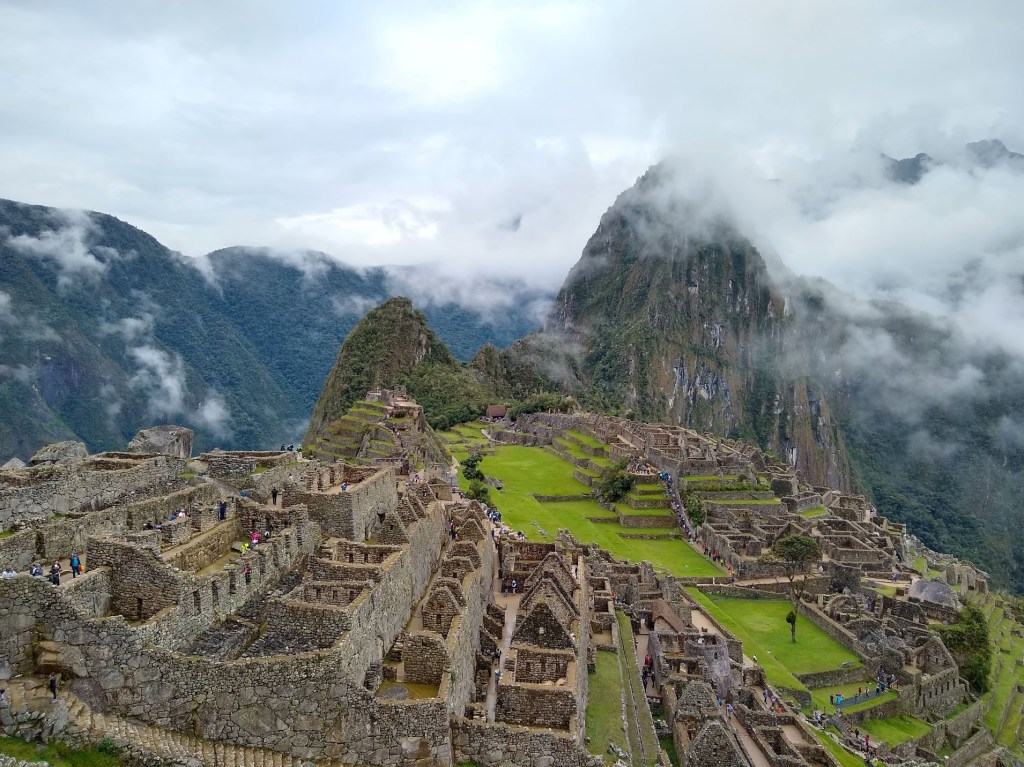
Wednesday, April 3, 2019:
I started packing on Sunday, ready for the 10-day trip ahead of me. Preparing for the weather that was to come, I packed short-sleeved and long-sleeved t-shirts, a windproof jacket, and many layers. I had started breaking in my new hiking boots the week before as preparation and was ready to go. I knew the flight would be long, seeing as how it left at 6 in the morning California time and wouldn’t arrive in Peru until 7 in the evening, Peru time, so I made sure to download an entire season of Umbrella Academy offline and bring my headphones and food. As I have allergies, it was kind of hilarious to see my medicine bag, which was chock full with Diamox for altitude sickness, montelukast for allergies, an inhaler, Claritin, an epipen, and instructions.
Thursday, April 4, 2019:
I had to wake up at 3:15 in preparation for the 6:00 flight, which kinda sucked, but it wasn’t that bad. I went to the airport, checked in, and took a seat with my group. I was super excited, seeing as how this would be my first international trip alone, but also nervous. After our flight from SFO to San Salvador, we took another flight to Lima, which was ended by a 1-hour bus ride where the school split up. I managed to watch about 7 hours of Umbrella Academy in the process, which is awesome. After, I was roomed with a good friend of mine, and we showered and went to bed. The hotel was called San Agustin Exclusive.
Friday, April 5, 2019:
We woke up when the alarm set and got ready before going down to breakfast. I could tell the Diamox I had taken yesterday would help, because already I could feel the altitude I’m the way I had to take deeper, stronger breaths. It all felt kinda like India, but less hot, humid, polluted, and loud. Diamox is honestly disgusting and hard to swallow, and the taste, if I don’t swallow fast enough, is disgusting. The food was pretty good, though I think we woke up too early, and soon everyone was done and ready. We went for a walk around downtown Lima after that, an area named after the Flores or the flowers. Apparently, some people left their cats in front of the church long ago, and the church started taking care of them. More and more people abandoned their cats to the church, and now there are more than 100 domesticated felines that live in the park and the area surrounding it, fed by the church and the people. I thought it was really cool especially since I’ve always wanted a pet cat, and they looked very furry. After the walk, we packed up, took the bus to the airport, and got on the flight. We had lunch at the airport, but I
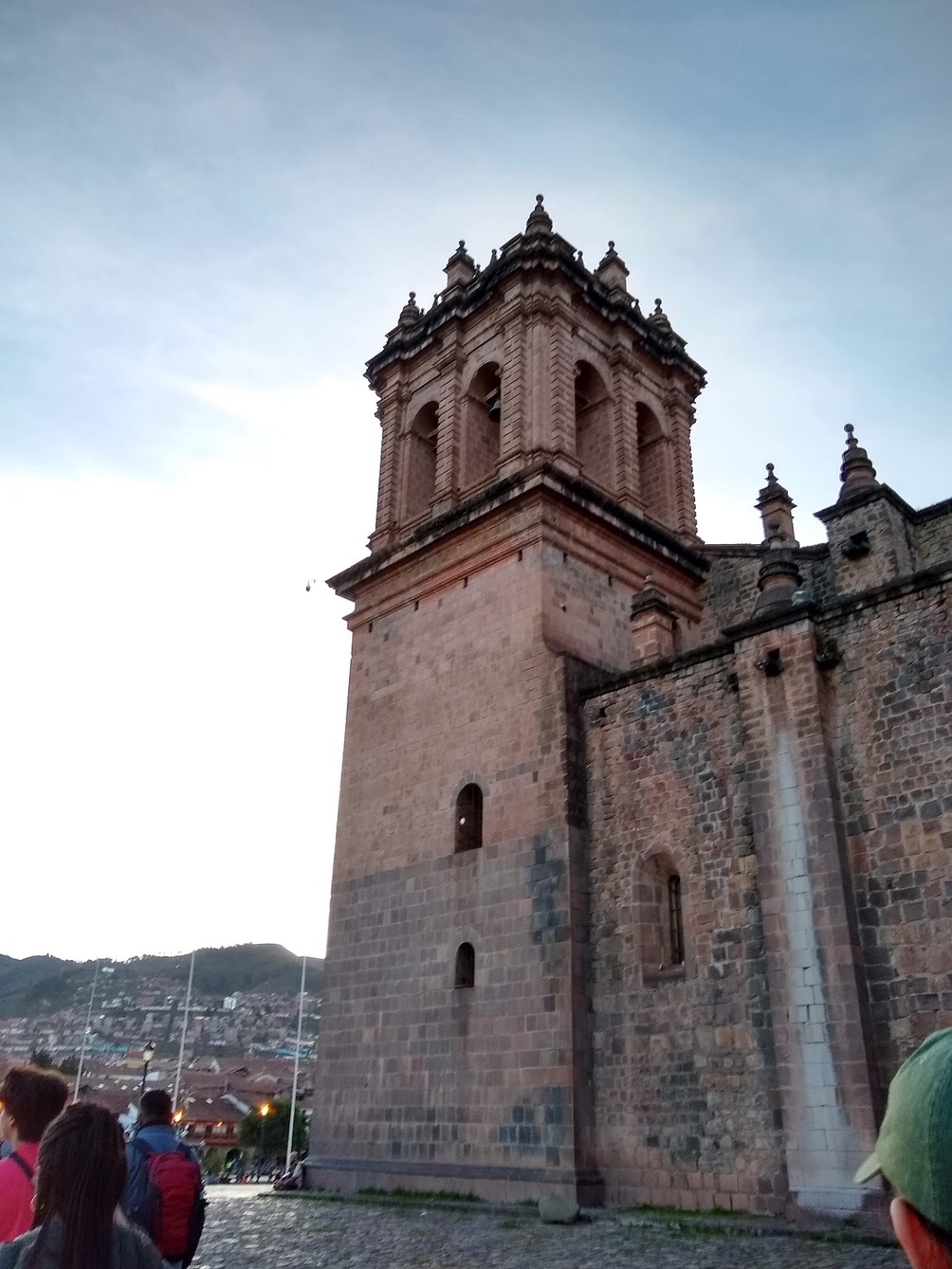
didn’t really eat what I was packed because the salad was surrounded by an unknown substance some people thought was meat. I ended up having a protein bar, muri, and peach. The ride ended, and we took vans to our hotel, Los Siete Ventanas, or the Seven Windows. After some time to settle in, we took a walking tour of Cusco. First, we visited the Plaza de Armas, a plaza where the Spanish conquistadors used to gather before the war. Our tour guide Al, from G Adventures, told us all about how there used to be a pyramid instead of a cathedral, and there used to be sacrifices on the summer solstice where the heart of a black llama or alpaca would be burnt to the Sun God, which is pretty cool. The culture is different than I expected – it’s more similar to India than I thought, with small street vendors in narrow allies, lots of stray animals, and sellers. According to Al, there are 18 churches just in Cusco downtown, which seems like overkill. The plaza was full of stray dogs, who apparently have owners who feed them like with the cats but don’t keep them at their house. After, we went to dinner, and I had salad, quinoa, and apple crumble. I took the fava beans out of the first two dishes because I didn’t like them much, and we walked back to the hotel. A shower later and I was in bed.
Saturday, April 6, 2019:
We woke up at 4 today, and after getting ready had breakfast, which wasn’t very good. I didn’t like the breakfast from this hotel, but after we were done we took our bags and suitcases, loaded them into the bus, and were off. It was a two-hour drive to the city of Ollyantambu’s train station, but the scenery was gorgeous. We were driving in a cloud, and though I was a little cold it all smelt fresh. I dozed off near the end, but still the train station we stopped and got in the train from Macchu Picchu Tours. This ride was about 1.5 hours, and it honestly felt like all we were doing was driving, but the scenery was worth it. There were cliffs and livestock and we went higher and higher, making me glad for my Diamox. One girl had already gotten a little altitude sickness that morning, and everyone in the group was on Advil or Diamox. I spent the ride just like the last – listening to music while looking out the window and taking photos, and my friend was bullet journalling next to me. The ride ended, but it was pouring rain, so we all put on our waterproof jackets and coats and set out for the bus station. There, we boarded a bus, and half an hour later we were at Macchu Picchu. It was… Beautiful, to put it mildly. The fog was thick originally, and
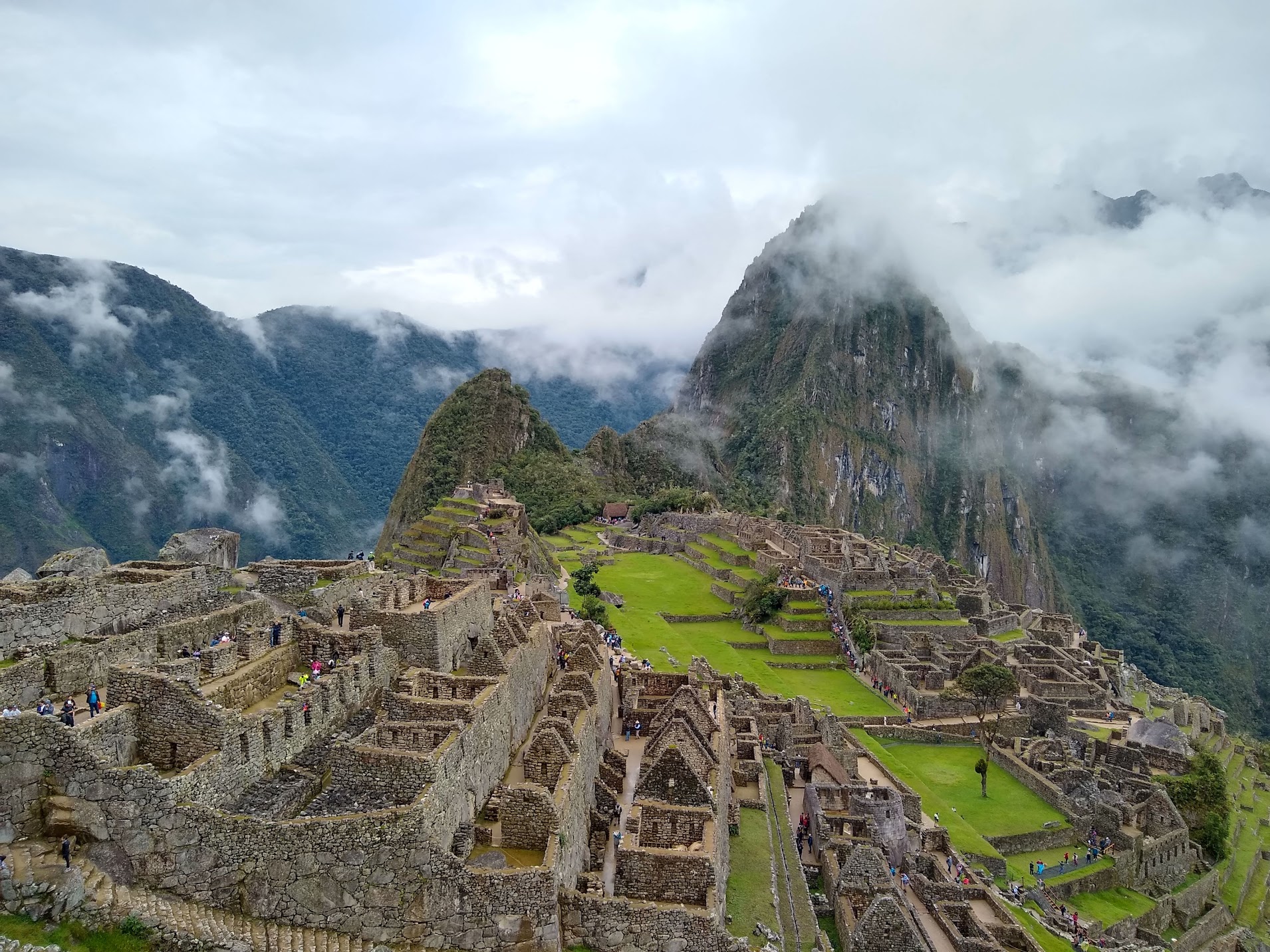
we were practically walking in clouds, but it started to clear up soon, and our new guide started taking us around. Macchu Picchu was a city meant to house around 1000 people, and they had the water for it thanks to aqueducts and gravity, and food because it was right next to the Amazon. Macchu Picchu was eventually abandoned for reasons unknown, and it stayed hidden and abandoned until 1911, when an explorer named Hiram, upon whom the Indiana Jones movies are based, discovered it. By then, the jungle had covered a lot of the city, but the rest was preserved. We also learned that the Incas solar calendar is much more accurate than the traditional Gregorian Calendar – it relies on the solstices, and the position of the sun, which could be tracked using angles and structures by the Incas. It also had an area where north pointed Down and south up, rather like the Mystery Spot in the Bay Area. The clouds cleared up, and soon it was hot enough that I had to take my 2 jackets off and put on sunscreen. Apparently, the area is a cloud forest so the weather varies and changes a lot. It was beautiful – that Earth has created such
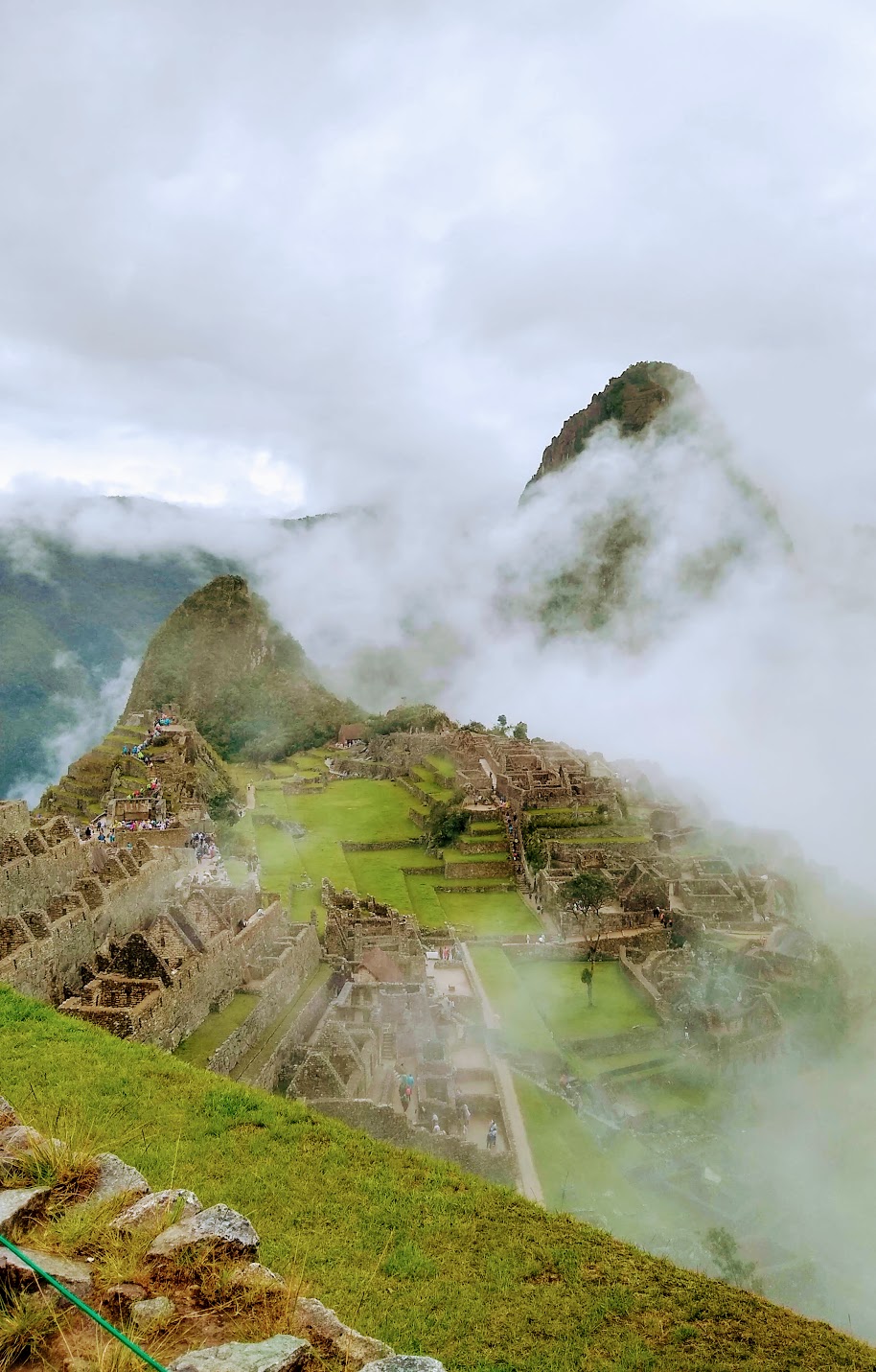
mountains and forests. After a long, 2 hour tour of Macchu Picchu, we took the bus back to the base. After the bus, we took the 1.5-hour train ride back, got on our G Adventures bus, and headed for our new hotel in Urubamba – Hotel Mabey. The overall Macchu Picchu experience was amazing and definitely worth the fact that I kept falling asleep and waking up every fifteen minutes on the train because I was too paranoid that I would miss the stop and my friend was already asleep, but it was also expensive. Though our tickets were paid for, the fact remains that train and bus tickets there and back are necessary, and to board, the train people need their passport. To enter Macchu Picchu people also need their passports and a separate ticket. We walked to the restaurant for dinner around seven, a ten-minute walk from the hotel. It was dark, and we had to use our phone flashlights to see, but the brightness of the stars was worth it. You don’t see stars like that back home. The food was decent though there were no signs, and I didn’t eat much. On the way back we saw three stray dogs, one of which was in a hole and looked as though it was only ahead. A shower, and I went to bed.
Sunday, April 7, 2019:
We were able to sleep in today, and I didn’t wake up until 7:30. Breakfast was really good – eggs, toast, strawberry yogurt, and coca tea. The cool thing about coca tea is that it comes from the coca plant, which is used to make cocaine. If I was to get a drug test done after having the tea, I would register as having had cocaine even though the tea is herbal, won’t get me high, and doesn’t have all the same properties as the drug. It tasted pretty good. At 10 we left on the bus for the city of Ollantaytambo. We reached, and after driving through the modern part we reached the ruins from Inca times. The hike up the ruins was tiring, to say the least, because the high altitudes meant that I got less oxygen and it was harder to catch my breath. It was also really hot that day, which made things worse. Our guide, Al, told us a lot about Inca architecture in the process. The Incas built with two materials – really large stones, or really small ones. With the small ones they were kept together with mud used as mortar, and less smooth. The large rocks were interesting, however, because no mortar was used. One would think that an earthquake
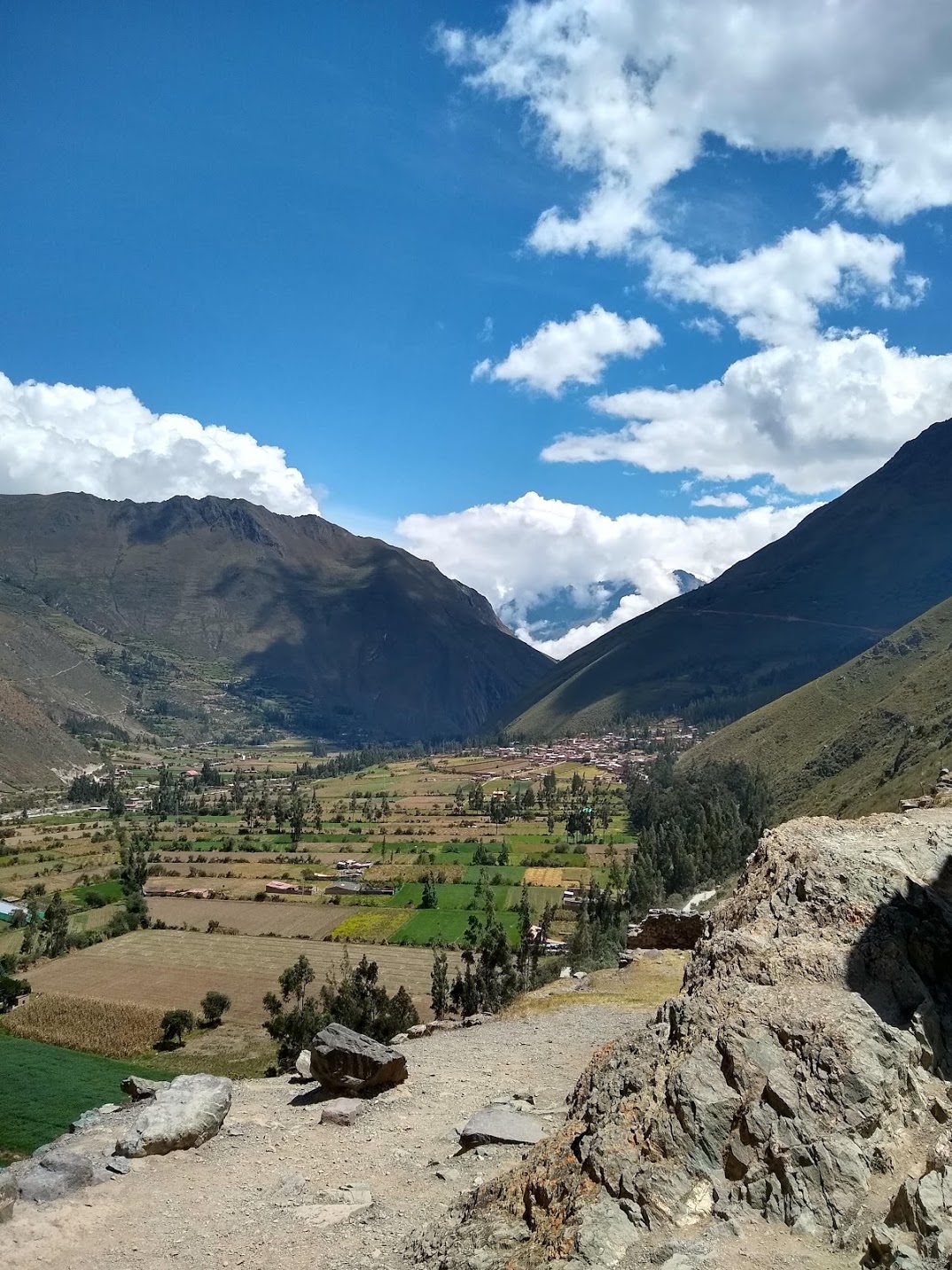
would bring the entire place crashing down, but the rocks were kept together using carved indentations in the rock, like Legos. There were also niches in the wall because the holes would help lessen the power of the earthquake as it moved, and smaller rocks helping cover gaps between big rocks that had to be created so the friction didn’t cause the rocks to explode. The entire structures go about a meter into the ground and rest on a thin layer of sand and pebbles. The pebbles are so that if there is an earthquake the entire structure will be more flexible to the movement. It was really interesting to me, these methods the Incas used 500 years ago because they are really advanced for that time. After that, we went down to the marketplace to shop, and I got a wind chime and a magnet. We walked to the restaurant from there, hardly a five-minute walk. Food was really good, brought in courses, and some of the other kids got to try to national delicacy – guinea pig. I didn’t, because I’m a vegetarian, but I shared a red corn drink with my friend. The restaurant was called Chuncho. After that we split up – some kids went on a long and steep hike, and the rest chose to hang out in the marketplace. We shopped for about 45 more minutes, and I got some keychains for my sister. Then we all gathered in the central square to play Mafia. There was this stray dog that kept interrupting us and grabbing our water bottles and funnily enough, he was just thirsty. We met back up with the hiking group then and went back to the hotel. In the evening we drove to dinner at a restaurant called Inkalicious, and the food was also good. They had pasta, which I was really happy about, and I had mango juice too. Back at the hotel, we reflected on the trip so far, then went to bed.
Monday, April 8, 2019:
We woke up at 6:30 today, getting ready, going for breakfast, and boarding the bus. The views of the rolling hills were amazing as we drove across the Sacred Valley until we reached a small town, where we entered a metal working shop. There, three men taught us how to forge Andean

Crosses. Using soldering, metal, and cutters, we cut through the metal to make a cross, twisted a loop to make a spiral, soldered the two together, hammered them into an arch, put it in acid so the residue could wash off, and then put the entire thing on a silver chain. I also polished it using rubber before putting it on the chain. The cross has three sections to represent the Incan belief in the three sections of the world – heaven, Earth, and the underworld. The spiral is in the middle to represent how Earth never stops, and it’s middle represents Cosco, which was the name of Cusco before the Spaniards renamed it. After, we wandered the marketplace for 15 minutes, and I bought a snake charm to replace the Andean Cross since it has religious meaning for a belief I am not a part of. Then, we headed back out to the bus, and an hour later we were at the Inca Rail train station. Walking through, we found ourselves at a small private school called the Cusca School. It’s really similar to Nueva – project-based learning and open, for ages 3-10. It was really cool, and on a
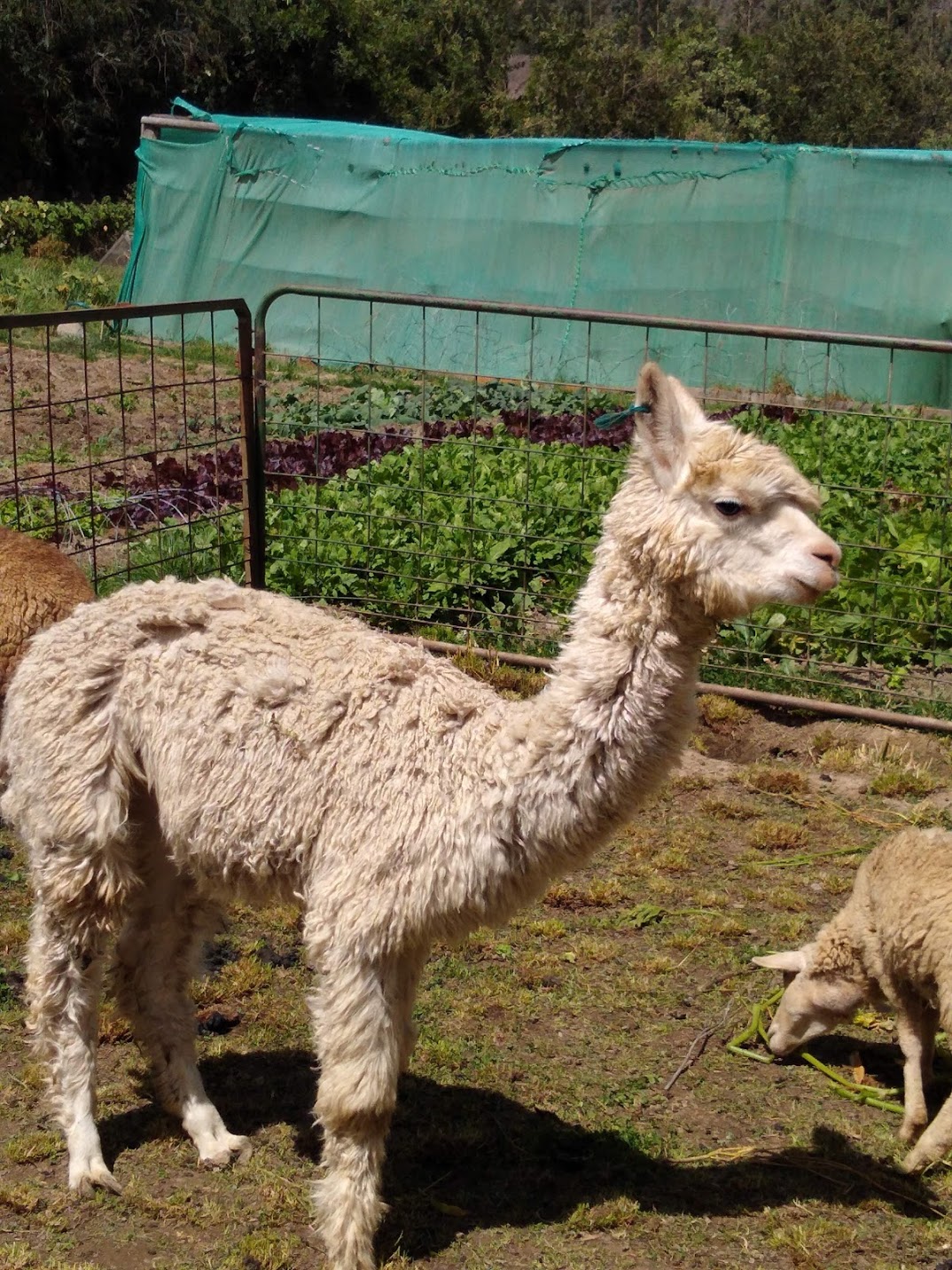
farm, so there were pigs, chicken, turkey, sheep, llama, and alpaca. I fed the sheep for a little, then we left. We walked to the lunch area and waited for about an hour, where I talked with some friends and related to one an abridged version of the Mahabharata. At this point, it was 2:30, and they hadn’t even started cooking the food because we were eating pachamanca or an old Incan style. Rocks are heated up on a fire and then used to layer and bury different foods. The rocks are then covered in herbs, cloth, then dirt in that order to preserve the heat like a convection oven. At this point, I was tired and fed up because the only thing they were making that I could eat was potatoes, and it was 3, so I had a protein bar before the meal. It turned out that it wasn’t the only thing they were cooking, and I had quinoa, potatoes, and salad. After lunch, which was actually really good, we drove back, reflected, and went for dinner in the hotel at eight. I had a decreased appetite, so I didn’t eat much, but the food was decent. After, I was tired enough that I just changed and went to bed.
Tuesday, April 9, 2019:
We woke up at 6:30 again, and got ready for the day ahead of us. After breakfast, we took our suitcases out of our rooms, loaded them in the bus, and set off on an hour drive through the mountains. We stopped at the square outside the Ollantaytambo ruins to pick up three people – a British man named Douglas and his wife, who worked on restoring terraces, and a farmer. From there we drove a little longer, then stopped. This was the start of our three-mile hike, and at the altitude, it took a while. We got winded easily and had to take a good number of breaks, especially since we were hiking uphill for the first part. By the second half, it evened out, and was easier, though we still needed breaks. The views, however, were gorgeous. Sloping green mountains,
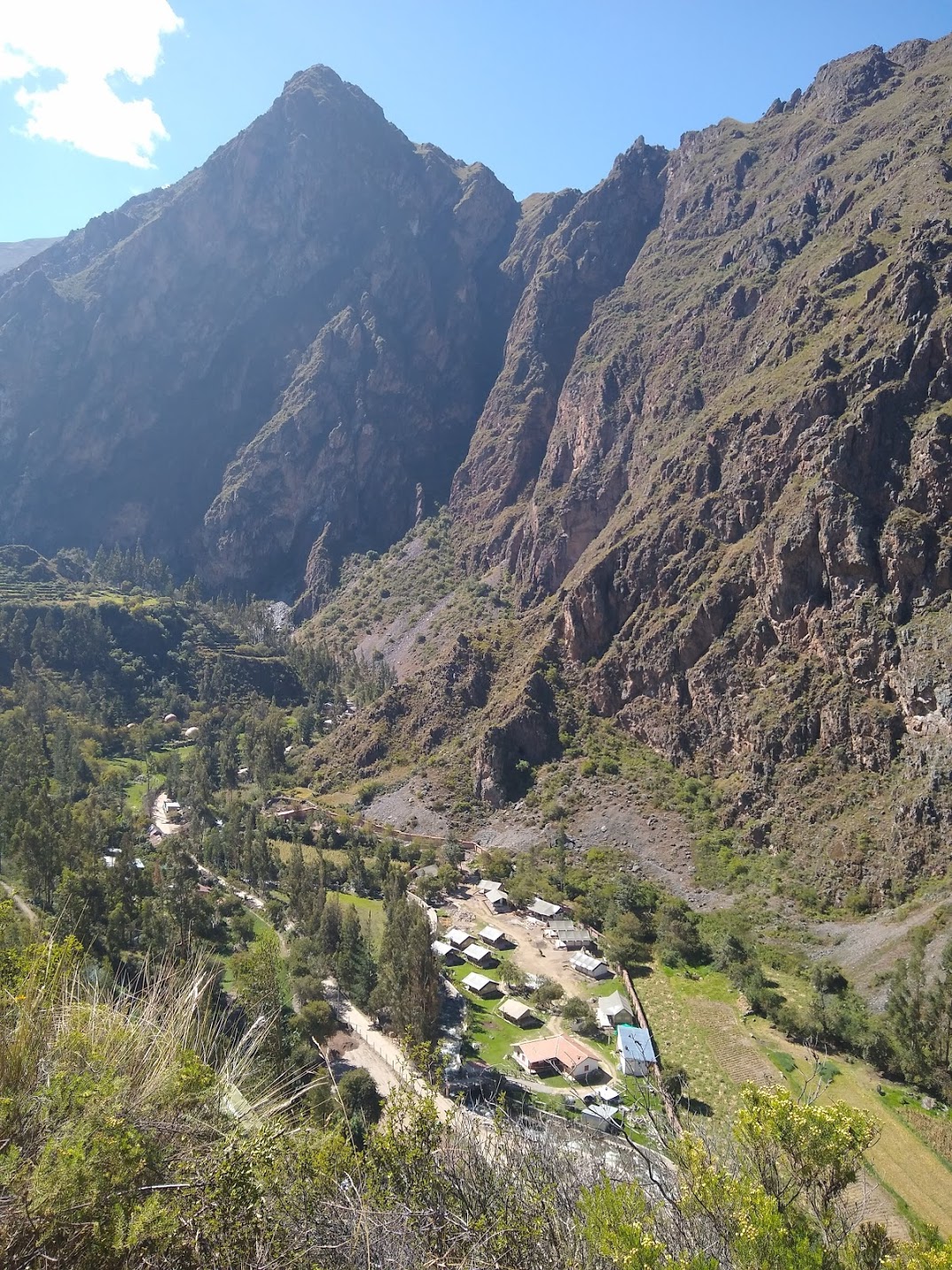
plants, and a river that we kept crossing as we hiked up, with cliffs that showed just how high we were. The path was narrow, only fit for one person. Around 1/4 of the way, we picked up a stray dog who started following us. He had a collar but not an owner and hiked with us until the end. Near the end, one boy also got altitude sickness, unfortunately. In the end, I was incredibly proud of myself, and we feasted on fruit, chocolate, and sandwiches. Some kids chose to take a smaller him uphill, but I was too tired and stayed with some other friends with whom I conversed about travel and food for the time. Once everyone was back, we boarded the bus and drove for a little longer until we reached a remote village high in the mountains called Huilloc. There we participated in many activities, like being gifted flower necklaces, dressing in their traditional garb, drinking their herbal tea, which was really good, and eating a buffet lunch of quinoa soup, vegetable tortillas, chicken, corn, and salad. After lunch, it started to rain, and we went to a shaded location to learn how the women made a living. Before this, however, we were treated to 4 young children performing a traditional dance for us and it was really cute. The weaving was fun – we learned about their farm, and how they made and dyed their own yarn and string using natural herbs to make scarves, bracelets, purses, hats, gloves, and more, all through our translator Doug. I then was taught one on one how to make a bracelet and helped make my own. The women spoke primarily in Quechua, but my Spanish helped me communicate, and at the end, I had a gorgeous bracelet. There was a sale after, from all the women, and I bought two more bracelets. One friend who hadn’t bought anything the entire trip got a scarf, one person a hat, and one friend another llama. It was a lot of fun, though the bathrooms were rather weird because they locked from the outside. We got in the bus, and we were off to Cusco, with a stop on the way to pick up one of the chaperones who had stayed behind. The drive was about two hours, and my favorite way to spend long drives is to listen to music and watch Life pass by through the window, which I did. We reached, walked to the hotel, got our rooms, and then went to dinner at a restaurant called Don Antonio. There was a live performance, which was pretty cool, and I enjoyed it since they were pretty skilled. Two were on guitar, one was on the wind, and another on drums. The highlight was when they played Despacito, in my opinion. We had passed a tour group that I recognized on my way to the restaurant, though we didn’t meet again. After, we retired for the night.
Wednesday, April 10, 2019:
Though we woke up early and were ready to leave by 7:30, it was found that a few more kids had come down with altitude sickness or a bug, and our number was reduced. We left at 8:30 Instead, driving to a weaving community. There, we were given an outstanding demonstration of how the women raise their own animals, use the fur to make yarn, dye the yarn, and knit or weave products to sell to tourists or other vendors all on their own. First, the fur is washed, then dyed in a lot by keeping it in hot water with the dye for 30 minutes. Their resourcefulness was evident – instead of detergents they used cactus root, and everything was done at the source. They were the real deal. The women have a partnership with G Adventures to bring tourists up so that they can sell their products more, and with the extra money, they are able to send their children to better schools and even colleges, since their community only has a kindergarten and elementary school. Girls start learning to knit or weave around the age of seven, while the boys and men work in the fields to make food. It seemed rather sexist to me in some ways, but it is how the community is
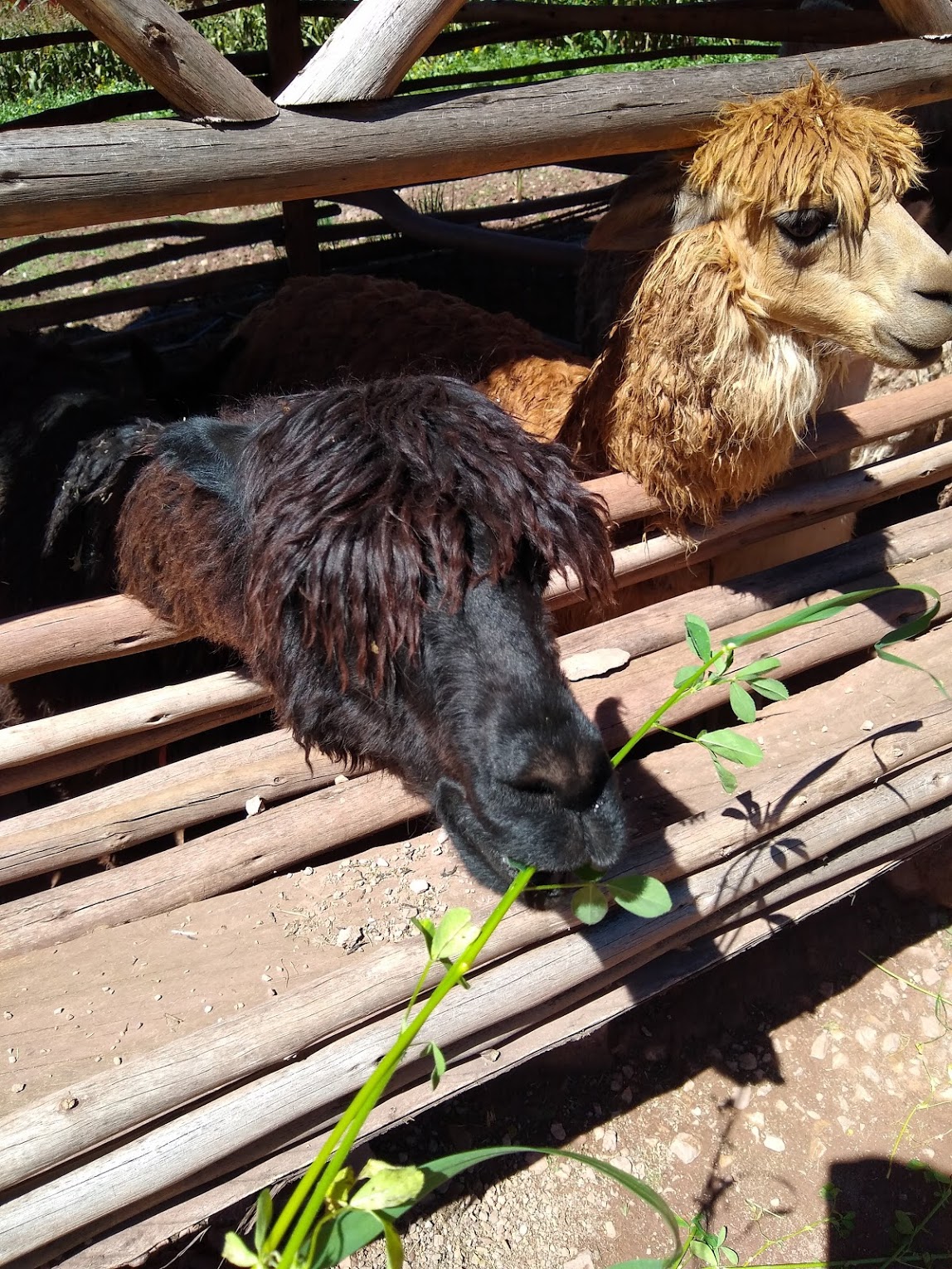
structured. I spent a lot of time feeding barley to the llamas and alpacas, who were extremely soft. I had gotten to feel different furs – sheep was the roughest, then llama, alpaca, and vicuna, which is so soft I felt like I was touching a cloud. I bought a hat for my mom, since her old one is ripping, and had a nice conversation with a friend on the ride back about what we got and our houses. We stopped after a while and walked to the Cusco Cathedral. It was really beautiful, and the first cross that the Spaniards brought to Peru was located there. Everything was in bright colors and gold or silver, and I couldn’t help but think that a lot of money was spent on those decorations that personally, to me, could have been spent other places. The beauty, however, was undeniably worth it. The paintings were gorgeous, but learning that they were made by Peruvian locals for the Spaniards changed my point of view. For example, In a painting of the Last Supper, the painter replaced the main dish with guinea pig and Peruvian fruits to spite their conquistadors. Continuing on, we learned that about 12 million people died in the time the Spanish were there, and a majority of them died because of the slavery they were put into. It was kinda horrific, and we also learned that their main statue of Jesus, called Lord of Earthquakes, was front and center because of festivals that would start soon. The statue was called Lord of Earthquakes because, during the 1600s, there was a terrible earthquake in Peru, Cusco specifically, with almost 200 aftershocks, and the people believed that they were being punished by God. When they took the statue outside and prayed to him, the earthquakes stopped. We also learned about how Incan culture survived – if the Spaniards called Mary the mother, and the natives saw Pachamama, or Mother Earth as their mother, they would combine the two. After the cathedral, we walked to a restaurant called Marcelo Batata for a cooking lesson. Unfortunately, three more people got sick and it was found that the five who had been sick before had a parasite due to the sketchy pizza they ate. There were few of us at the cooking lesson as such. First, we sampled different fruits – starfruit, mango, passion fruits, granadilla, gooseberries, and more. The mango was my favorite, but I also really liked the sour passion fruit and a thick fruit with the consistency of sweet potato, but the flavor of caramel and butterscotch. After, we split up, and I got a tour of their food market with some other people. We learned more about the three types of quinoa, the many different types of potatoes, and how there are studies that say that corn originated in Asia. There is also apparently an herb called Maca, which absorbs all the nutrients in the ground and makes the soil unusable but is incredibly healthy and a natural vitamin supplement. We learned more about Coca too – how it is banned in many countries because it is used to make cocaine, but is actually really good for one. When chewed it gives a burst of energy and removed the need for hunger; something the Spaniards, unfortunately, took advantage of when enslaving Peruvians by only feeding them coca and water. I’ve had Coca tea, and it was a good tasting herbal tea. After, our group was given a demonstration on how to make ceviche, the national dish of Peru. I chose to skip out on that because it is a seafood dish, and I wasn’t comfortable. We sampled potatoes next – 6 potatoes and three tubers, along with potato chips. There was salt and sauce for us to dip them into, and I really enjoyed the tasting, especially since I was starving by then and it was 2. It was time to make drinks then – we made virgin mojitos. By mixing half an ounce each of passion fruit juice, lime juice, and sugar syrup with a cup of ginger ale we made a delicious drink I enjoyed. Next was cooking – the vegetarians fried zucchini, while the others fried alpaca. We were making a dish called Lomo Saltaro. It involves cooking with fire, and at one point, after I poured pisco into my dish, the entire plate started burning. It’s a relatively simple meal – vegetables, which we prepared during ten minutes of extreme stress while the head chef absolutely SCREAMED at us to smile for photos, and rice and potatoes. I liked it, a lot, and after, we walked to the hotel, Siete Ventanas again. I personally didn’t like the hotel much – the shower was faulty, and we found a spider in our towels. I liked the other two much more. We left the hotel around 5:45, and reached the Cusco Planetarium soon after. This planetarium is not a government organization but a private project. My favorite creature, there was their pet white dog, Gandalf. We sat in the indoor planetarium and watched the stars pass over us as our guide explained the different constellations: cancer (me), Aries, Taurus, Gemini, Capricorn, and more. I was honestly astounded by just how much creativity was put into the pictures when most of the constellations had no resemblance. I loved the talk about stats though because most of them either have a relationship to Harry Potter or Greek mythology. Sirius, Regulus, Leo, Lyra, Orion, Castor and Pollux, and Bellatrix are some of my favorites. We also learned about Incan constellations – dark constellations such as the black llama, which to them represented the seasons. During their dry season, the llama comes down the Earth and drinks a lot of water, and then the wet season is the llama peeing the water back down through rain. It’s really cool to see how different cultures rationalized different phenomena. We went outside to look at the real stars for a while, and we got to see a star cluster Called the Pleiades, from Greek myths, Castor and Pollux, though Castor is actually two stars really close together, and the moon. The craters on the moon were unearthly in a beautiful way, especially after my reading of the Lunar Chronicles. We got dinner after, and I mostly had the pumpkin soup. Then we went to the hotel and to bed.
Thursday, April 11, 2019:
We woke up, packed our suitcases, brought them down, and had breakfast before leaving around 8:30. Three more girls had fallen sick, and of those who were still in the group, there were ten out of 16 originally, with two recovering. We visited the ruins of Q’enco first. It used to be a sun temple before the Spaniards came in, and then, in order to convert them to Catholicism,
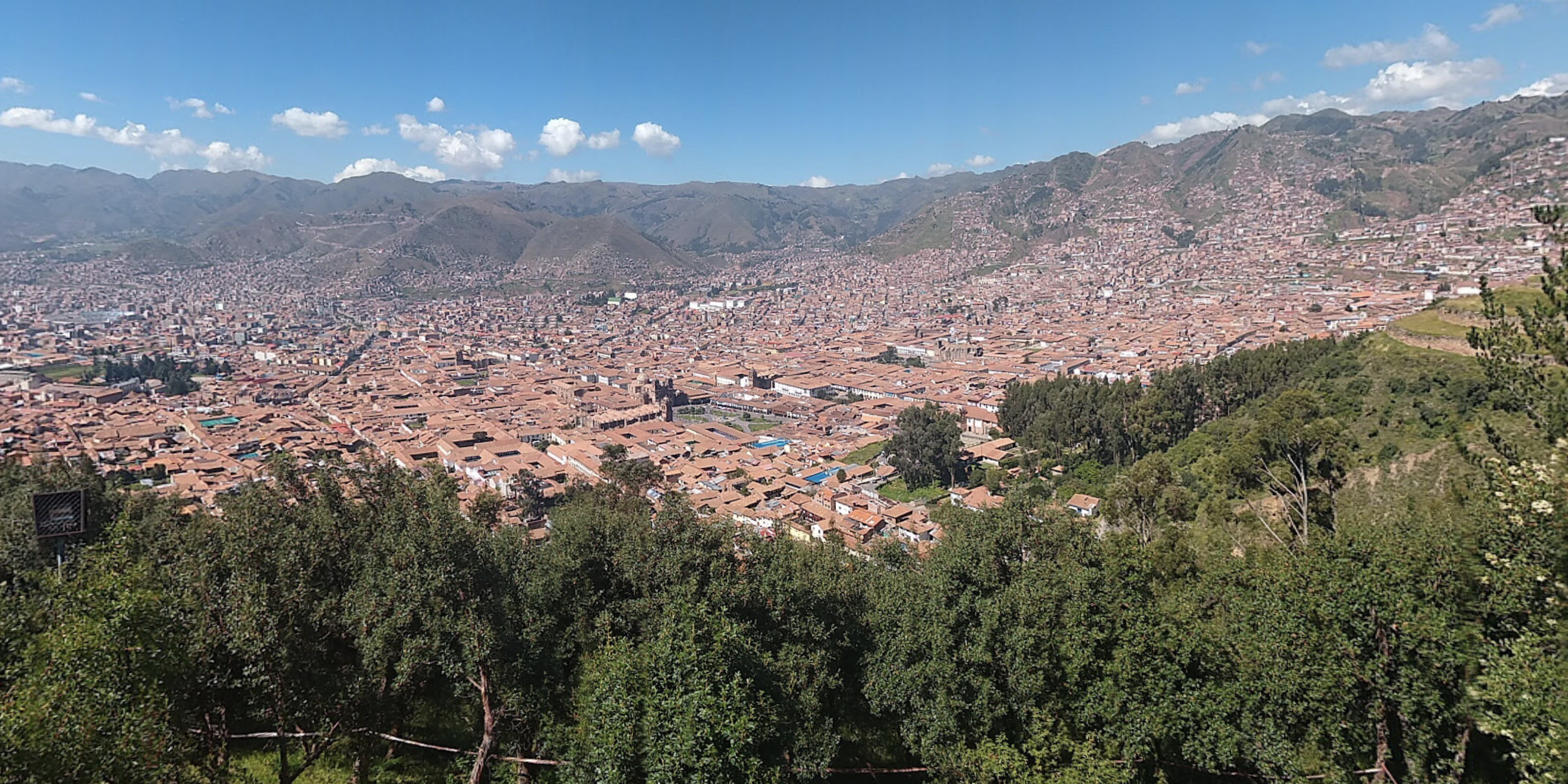
destroyed many of their temples or turned them into cathedrals. There was also a lot of eucalypti because when the Spaniards finally left they had deforested most of the land and left it bare. The new government decided that eucalyptus would help with the forestation because of how fast it grows. Then, we took a quick drive to a large white statue of Jesus that overlooks the city. That done we took a drive to another set of ruins called Saqsaywaman. They were beautiful, and we got to see animals like alpaca and sheep roaming in their natural habitat. There were fun rock formations there we took turns sliding down because of how smooth they were, and then we had time to wander. I looked around and helped my friend take photos of her in various gymnastics and fencing positions. We went for lunch at a Peruvian Chinese restaurant called Kion, and I enjoyed my spring rolls and noodles. The kids who had gotten sick had to drink an electrolytes solution that tasted absolutely horrible, unfortunately, and could only have plain noodles with nothing else.

After food, we went to the Choco museum and wandered a little, sampling different chocolates. I eventually bought two bars of dark chocolate – 70% and 85%. We then went shopping for about an hour though I bought nothing as none of it appealed to me. There was a parade or celebration that day, and I took the time to watch their traditional dances and dress on the streets though I don’t know what they were celebrating. We stopped at the hotel for a bit, then went to our dinner restaurant. This restaurant had many branches in Cusco, and we accidentally went to the wrong one, so our order wasn’t ready. I ended up ordering a salted avocado dish from the menu, which tasted really good. That done, we got on our bus and drove to the airport. Our flight reached Lima around 9:30, and we were in the hotel by 11, exhausted.
Friday, April 12, 2019:
Today was all flying back home, and I was really excited to meet all my friends. I watched three movies on the flights – Crazy Rich Asians, Gifted, and Hunger Games. I had watched Iron Man 2 on the flight here. I loved the trip and all the new experiences Peru brought because it gave me a new view of the world. Theirs is a world more centered on agriculture, and the happiness, creativity, and resourcefulness they project are something to be admired.
 Niharika Agrawal
Leave a comment