

The cause of the First World War is not clear to many historians simply because of how many factors were in play at the time, and while many blame the start of the war on the assassination of Archduke Franz Ferdinand of Austria, larger forces were at play. Most of the blame can be placed at the feet of the states: certain states, due to issues politically or domestically, incited strife and conflict. The catalyst to WWI, though not the ultimate cause, took place in the Austro-Hungarian Empire due to nationalist sentiment, and spread due to both nationalism and imperialism. Nationalism comes in two forms: popular nationalism, or the identification with one’s people or religion, and civic nationalism: the unity and identification with one’s state and government. Imperialism is how countries at the time spread their power—by using force to dominate other countries. Ultimately, it was popular nationalism that sparked the fire of the war and then civic nationalism and imperialism that fanned the flame, prolonging it.
Popular nationalism lent itself to the war as the catalyst to WWI in Bosnia, a state in Austria-Hungary where the South Slavs resided. This is where popular nationalism came into play: Slavs, who resided in Bosnia and Serbia, a state outside of Austria-Hungary, “were Eastern Orthodox and so closer to Russia… With the Slavic Revival, which emphasized language, many of these peoples came to feel that they were one people, for which they took the name South Slavs, or Yugoslavs.” Unfortunately, the Slavs were an ethnic minority at the time—after Austria and Hungary united in 1867, “the Slavs of the Habsburg Empire were kept subordinate to the German Austrians and the Hungarian Magyars,” which were Roman-Catholic. Nationalism had already had a profound effect on the geography of Europe at the time after popular nationalist groups created many new countries: Bulgaria became fully independent, and Crete united with Greece, among others. Popular nationalist sentiment was even further aggravated when the Bosnians were unable to join with Serbia as they wished. This created much resentment among the South Slavs, especially when Serbia, a country just to the Dual Monarchy’s south, was a center for the Slavs. Thus, the popular nationalist sentiment to break free of the Austro-Hungarian Empire and be in a country full of their religious group created unrest in Bosnia and Serbia until ultimately, on June 28, 1914, a Bosnian revolutionary, who was a member of a secret society known as the Black Hand in Serbia, assassinated the Archduke Ferdinand. This focal event, caused mainly by popular nationalism in Bosnia by the South Slavs, is ultimately the spark that ignited the war.
While the assassination of Archduke Ferdinand was the spark that started the war, sparks cannot burst into fire without something to fan the flame, and the civic nationalism of Austria-Hungary was one of the key aspects that fanned the flame of war in Europe. At the time, Austria-Hungary was having political issues in the government due to opposing factions from Austria and Hungary both vying for more power in the empire. The empire originally united after fighting over Austria’s suppression of Russian support for Hungary, among other causes, and eventually, the two countries agreed that joining together in a compromise made more sense. Even after the union of the two empires, “overlapping responsibilities between the joint ministries and the ministries of the two halves caused friction and inefficiencies” because of how separated the governments still were. The assassination of the Archduke was an opening that the government pounced upon. There is an idea that the opposite of “divide and conquer” is to “unite and build”—nothing does this more effectively than war because as Charles Tilly states: “war makes states and states make war.” A war would not only “end the South Slav separatism that was gnawing its empire to pieces,” but it would
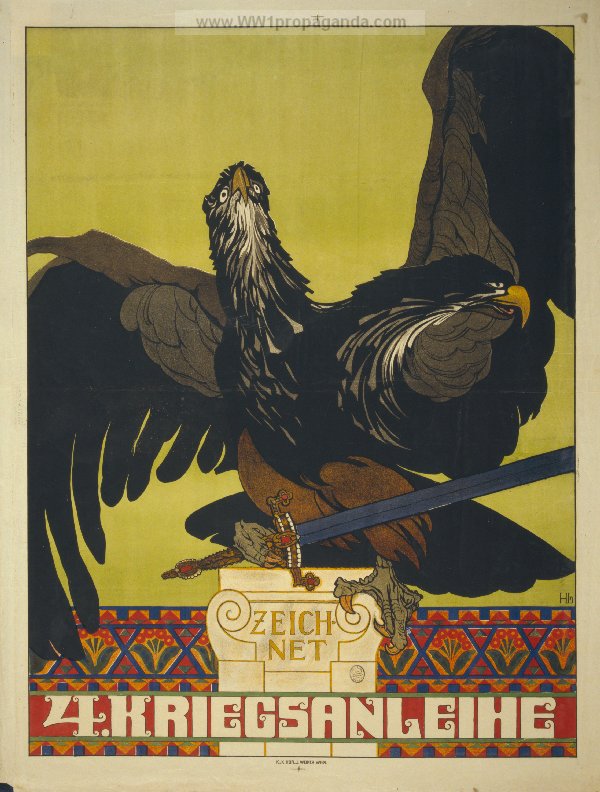
give the rest of the empire a banner to stand behind, end the civil discourse, and unite the state through war. Propaganda was an efficient means of how the government stirred up civic nationalist sentiment: the propaganda poster to the left, for example, pictures the double-headed eagle of the Austro-Hungarian Empire clutching a sword, to evoke a sense of patriotism. Thus, the Austro-Hungarian government was able to evoke a sense of civic nationalism in the people of Austria-Hungary and unite the empire better than before.
Nationalism does not account for why Germany, Great Britain, France, and Russia all dived into the war eagerly, however, and in this case, the blame can be placed at the feet of the idea of imperialism and not the many alliances that existed before the war. After Austria-Hungary declared war on Serbia, other countries joined quickly and consecutively like a series of falling dominoes. Russia, expecting that Austria-Hungary would be joined by Germany due to previous alliances, “rashly mobilized its army on the German as well as the Austrian frontier.” Because of that, the Germans demanded that the Russians stop mobilizing on their border, and, receiving no answer, declared war on Russia on August 1, 1914. They then became convinced that France would join the war anyway on Russia’s side, and so preemptively declared war on France on August 3. Thus, in the matter of one fateful summer, all the major powers in Europe declared war on one another and swept up smaller and allied countries into the fracas with them. Even Great Britain, a generally isolated but powerful country, declared war on Germany due to broken treaties and because it had played the role of the ‘balancer’ in Europe since the 1700s. These countries did not just join rashly. All had one thing in common: every single country desired to imperialize and divide up the Ottoman Empire at the time, and due to the geography of Europe, they were unable to because Austria-Hungary stood solidly in their way. Thus, the empire became a focal point to the war. Germany allied with the Dual Monarchy because the alliance would give it access to Ottoman land. Great Britain and France both knew that if they defeated the Triple Entente then they too would have the ability to imperialize the Ottoman Empire. Even Italy, desiring land in the Balkan areas to imperialize, sided with France and Great Britain to create the Triple Alliance. Thus, due to the overarching desire from many European countries to spread their imperialistic grasps, the war overtook all of Europe.
Thus, when looking at the causes of WWI, it comes down to a series of ideologies that were intrinsic parts of the countries—imperialism, civic nationalism, and popular nationalism. Without imperialism, the countries would not have been drawn into the war by the promise of land and the power that came with the land. Without civic nationalism, the citizens would have tired of the government’s war-mongering and protested against the war. Without popular nationalism, Europe would have been more stabilized at the time and the assassination of Archduke Ferdinand would not have happened. Numerous things contributed to the war, compounding alliances and a reckless willingness to prepare for a war that might never happen among them, but in the end, these three ideologies caused the war and spread it to all of Europe and eventually the world.
 Niharika Agrawal
Leave a comment