
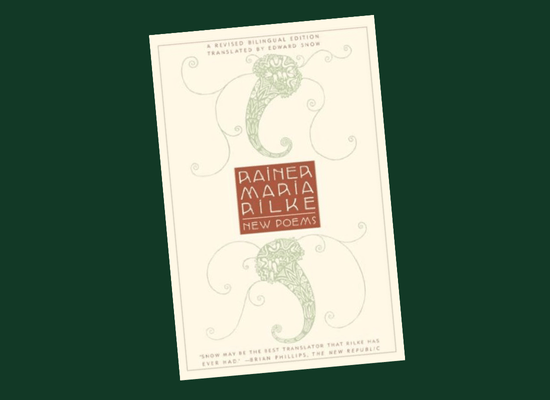
New Poems by Rainer Maria Rilke and translated by Edward Snow, is a fascinating collection of poetry that explores themes like mythology, love, nature, time, and death. Rilke further complicates things by connecting poems between his first and second collections of poems, both put together in this book. The themes are not alone either: poems about mythology can also be about love, or about time. His writing is often fatalistic, with vague, questioning endings that hit hard with the reader because they are not specific, and do not answer the questions he poses. Rilke himself does not seem to know the answers to the questions he writes about—he simply explores the themes, and it is in this uncertainty that his best writing emerges.
A huge theme of his poetry is mythology and lore: he focuses mainly on Greek and Christian mythology in his poetry, writing poems such as “Archaic Torso of Apollo,” “Adam,” “Eve,” and “Leda.” He uses these poems not to retell myths, but to ask questions. For example, he connects “Adam” and “Eve” to ask specific questions and reverse commonly thought-of roles. Adam is the one who longs to escape the “Garden of Eden into the new earth,” and Eve “wished she could have stayed / just a bit longer” (Rilke 207-209). His questioning pushes readers to really think about the original myth, and what it means to us. The tale of the Garden of Eden is so ever present that even if one has no personal connection to Christianity, the poem still forces the reader to truly reckon with the idea of original sin and longing.
Another pair of poems he connects is the “Archaic Torso of Apollo” and “Cretan Artemis,” both used to describe more ancient versions of Gods that spent centuries evolving in Ancient Greece. Rilke uses these poems to explore the concept of human beings molding our perceptions of what the gods can be: he thinks about a statue of Apollo and wonders whether we create meaning in the statue simply because it is about Apollo, or whether Apollo himself imbues meaning into the statue. He says, “We never knew his head and all the light / that ripened in his fabled eyes” but still the stone glistens “just like the wild beasts’ fur” (Rilke 183). About Artemis he states, “did you shape her, molding / her garment to the unconscious breasts / like a shifting premonition?” (Rilke 185). Rilke forces you to contend with our perceptions of the old gods and mythology, perceptions that have shifted over centuries and millennia, and truly wonder whether there is a truth hidden underneath all of our musings, or whether we simply create the gods we wish to see. We see the latter in the recent reemergence of mythology retellings, where women look at old myths and bring new life to the women in them, emphasizing their roles and forcing readers to contend with the humanity of women who are hardly given agency in the old stories. Authors rewrite the stories of heroines such as Eve, Kaikeyi, Penelope, Clytemnestra, and more, and in doing so reshape and remold our perceptions of the gods and mythology with nothing but their words, just as Rilke does.
Rilke also explores love in his book, but specifically more brutal perceptions of love that blend the individual members of a relationship into one and questions how we choose to love. In the poem “Sappho to Eranna, ” Sappho says, “I want to pierce through you / and pass you on like the grave to life,” a line that is both beautiful in its emphasis on Sappho’s love for Eranna, and sexual in meaning as well. It represents one being pierced by Cupid’s bow as much as it represents the deep connection formed between people in a relationship, when they feel as though they want to be one, especially during sex. In the poem “Love Song,” Rilke writes, “yet whatever touches you and me / blends us together just as a bow’s stroke / from two strings draws one voice” (Rilke 11). Rilke sits down and asks us about our individuality in love: as we spend more and more time around our lovers, do we retain our individuality, or does our impact on one another meld us together? In old Greek mythology, for example, humans originally had two heads and four arms and legs, but Zeus ripped humans apart into two individual pieces, who then searched for their ‘soulmates.’ What do we sacrifice when we find love? In “Sacrifice” Rilke asks, “Since I first saw you; look / I walk slimmer now and so much straighter, / and you only wait—: who are you then?… I’m shedding my old life, leaf by leaf. / Only your smile stands like pure stars / over you and soon now over me” (Rilke 23). Rilke writes love as beautiful, but scalding, like a burning flame we have to walk through and are reborn in. He writes of a love that peels our skin off and creates us anew by the hands of our loved ones.
Another theme that permeates Rilke’s poems is one of timelessness: Rilke explores how in many ways, we can exist beyond the boundaries of time and death. In “Roman Sarcophagi,” he states, “Just as once in this carved sarcophagus… something slowly decomposing lay… Where waits and thinks / a brain that one day will employ them?” (Rilke 75). In this poem, the dead in the sarcophagus become eternal and timeless. In “Quai du Rosaire,” he writes, “did this city not perish? now you see how / (obeying some unfathomable law) / it makes it grows clear in a transposed world” (Rilke 131). Rilke asks—does something that dies ever truly die? Or does it simply wait for a chance to be born anew into a new world, in a different form? Can this city perish? Or does it wait, adapt, overcome? Do we die? Or do we linger in this world, unseen, but there nevertheless. In “Faded,” Rilke writes that she “looks after a fragile room / which she keeps clean and well-tended/ in case that same young girl / may still be living there” (Rilke 225). Is the young girl dead truly dead, Rilke asks, or does the preservation of her room speak to her timelessness? Rilke asks if we truly die, or if we live on in every item we touch, every place we used to be, and in the minds of every person we meet. Despite the seeming melancholy of poems such as this, a closer look reveals a hopeful outlook on the world, where we achieve immortality just by existing.
Rilke’s depiction of women is particularly fascinating: for a poet from the late 1800s, he wrote about women in a remarkably feminist way—women, in much of his poetry, are almost otherworldly beings. They are not perfect depictions, but they are interesting, and I think that is more important. In “The Courtesan,” the courtesan says, “And boys, the hopes of ancient houses, / perish at my mouth as if by poison” (Rilke 113). There is a sense of otherworldly danger to her, a sense that is repeated in the poem “Spanish Dancer.” Rilke writes: “With a glance she sets a blaze her hair / and whirls suddenly with daring art / her whole dress into this fiery rapture, / and out of that, like startled snakes, / two naked arms emerge, aroused and rattling” (Rilke 125). Women in Rilke’s poetry embody every single one of the themes discussed above: they love, they are many times from myths, they are powerful, they are timeless, and more. One of my favorite lines in the book is from the poem “Orpheus, Eurydice, Hermes,” where Rilke says about Eurydice: “She was no longer the blonde wife / who echoed off in the poet’s songs… She was already loosened like long hair / and given over like fallen rain / and handed out like a limitless supply. / She was already root” (Rilke 145). I think it is an incredibly powerful line—Eurydice is transformed from just a young wife who died to a powerful, rooted tree, embedded in the ground, her strength in her steadiness. It is not the first time Rilke compares women to nature either. In “Spanish Dancer,” the woman is fire, in the last poem she is a tree, and in “Tombs of the Hetaerae,” he writes, “And they were riverbeds / over whom in short, rapid waves / (all eager to go on to the next life) / the bodies of many young men hurled themselves” (Rilke 137). Each time, the woman is something powerful, rooted, timeless. She does not start and stop at the whims of the people around her, not even at the whims of the gods. She simply is.
Rilke’s exploration of mythology, love, timelessness, nature, and more are embodied clearly in New Poems, translated beautifully by Edward Snow. Each poem is beautifully written, and it is not only the topics of the poems that make it beautiful, but the structure as well. Rilke utilizes enjambment in almost every single one of his poems to force readers to pause where they might normally not, and really think about what they have just read. His lines are short, cut off at just the right place to make the rhythm of the poem shine through. His poetic structure works well with the themes of his poems and overall, New Poems is a beautiful, harmonious collection of poetry.
 Niharika Agrawal
Leave a comment