
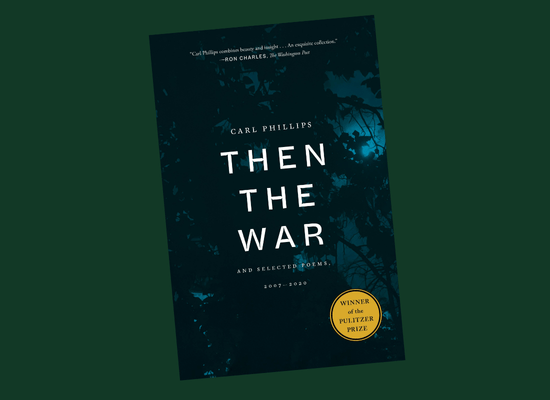
Carl Phillip’s book Then The War, which comprises both new and old poetry, is a nuanced exploration of love, relationships, and memory, all tied up in beautiful naturalistic language. The book examines conflict, Phillip’s own relationship with race and his identity as a gay man, and demonstrates the evolution of his writing style over time. In his own words, “Story, versus information. Lyric, versus didactic. Long, period sentences, versus clipped, straightforward ones” (Among the Trees, 42). The first section of his book, the new poems, comprises of mainly free verse poetry that reflects the disorienting nature of his poems and the leaps in logic he makes. His imagery is concrete, allowing readers to truly feel what he means.
Love is a theme he, like many other poets, explores in full in his book. He describes love with flowery metaphors related to nature—“The dragonfruit / cactuses, ornamenting the yards we walked past, hadn’t / flowered yet, but soon would, the way what isn’t love—at all— / can begin to feel like love” (Of California, 6)—or with religious metaphors—“Love— Isn’t love / what they used to call holiness once, long ago, on earth?” (On Coming Close, 58). Both demonstrate the almost otherworldly nature of the emotions and how he feels them. He even relates love to politics, with which he is intimately acquainted with: “If we can make, from tenderness, a revolution” (Fixed Shadow, Moving Water, 22). That last line is one of my favorites, demonstrating how at the heart of every movement is human emotion, like tenderness and empathy.
Phillips writes not just about love, but about relationships with people in general. His writing speaks to his unique experience growing up as a gay man in the 80s and 90s, with phrases such as “What is cruising, if not a form of hunting, if not to pass, as animal (the act of sex is perhaps our most animal manifestation, as humans), in pursuit of another human who has chosen fro the moment to yield more entirely to the animal that each of us carries inside?” (Among the Trees, 35). He writes about loneliness and the lack of relationships using beautiful nature metaphors “Gulls scattering before us, say, the way / the letters that spell loneliness can scatter, eventually / as if weary with meaning—with having had to mean— / from what loneliness really deep down feels like: / magnetic, unignorable; why, / the waves themselves bow down” (Only Portions of the Map Still Legibly Survive, 65-66). Something unique about Phillips is how he uses poem titles: they sometimes seem almost entirely unrelated to the actual subject matter, and on rereading, add new depths to the poem. For example, he has a poem called “Entire Known World so Far” where he writes “The map makes / the world seem like a human body / when it’s been stripped and you can finally / see it for the world it is: plunderable” (Entire Known World so Far, 73). The title adds new meaning to the idea of the world being plunderable, especially as humans continue to strip the world around us for resources.
Phillips also writes about memory, and how history can influence memory. For example, he says: “Sometimes the past seems like the stuff of heraldry, / figures proper on a ground of good and evil. Other times / the past sways ocean-like above me” (In a Low Voice, Slowly, 21). He also writes about how memory can be faulty, saying “Evidence is not the same / as memory. He’d forgotten, years ago, the question, but the answer— / it never left him, or hardly ever” (Like the Sweet Wet Earth Itself, 57). It is true indeed, that evidence is not the same as memory, and it s further true that memory influences people differently. For example, Phillips muses on race in “Among the Trees” and says “I can’t help thinking about the place of trees in African-American history, as the site for lynching. How strange for my father, an African American, to find it a fitting punishment to leave his son hanging in a tree at night” (Among the Trees 31). Phillips’ father has a different relationship to memory and time than Phillips, evidently.
Then the War’s first part is a beautiful collection of individual poetry about love, relationships, memory, and more, all tied up in nature metaphors. The poem titles, for example, even if they seem to have nothing to do with the poem, will be things like “The Enchanted Bluff,” “The Blue Winged Warbler,” or “To Autumn.” Free Verse is as loose-flowing as nature itself, taking readers through Phillip’s mind as he grapples with and writes about the world in poems rife with enjambment and odd rhythms that force readers to truly confront the lyrics of the poem. I would love to try mimicking Phillip’s nature-heavy style of writing and truly connect to the world around me more in my writing, instead of just looking internal.
Part 2 of Carl Phillip’s Then the War, a collection of his old poetry, explores longing, control, memory, and internal conflict, tied up in naturalistic language. The poems are informed by Phillip’s race and sexuality, and demonstrate how his writing style has changed in comparison to the first part of the book. The leaping free verse he has known for is slightly more structured in these older poems, reflecting the change in his writing style.
Phillip’s has many poems about longing and love, in his distinctive vague metaphors. For example, he asks “That part about the body / asking for it, / to be broken into—is that the first, or last part?” (Mirror, Window, Mirror, 88). I love this line and the way it describes the complications of longing. Compared to his newer poems, his prose tends to be a bit more direct in terms of what it discusses, and his titles less related to nature and more to general, vague themes that might have nothing to do with the poem upon first glance. In “Glory On,” for example, he writes “I could have sworn I’d lost my taste for you / you being an accident like all the others,” which seems to have nothing to do with the title (Glory On, 106).
Relatedly, his older poems talk more about themes of the body, and having control over the body. This is most likely related to the fact that Phillip’s was simply younger when writing these poems, and was still exploring and discovering his sexuality and self in a way an older poet is not. He writes “In the book of the body that is yours,” relating strongly to themes of possessiveness and longing (Captivity, 89). It is also intimate, indicating that the author knows the body of the person they are talking about well. Phillip’s further writes about self control, over the body and mind, when he says: “Let me show you what it looks like / when surrender, and an instinct not to, run side by side” (Distortion, 93). I particularly like this line, not just because it reminds the reader of wolves running side by side (or any other animal) but because it is indicative of the fact that we are constantly exercising self control over our intrusive thoughts and instincts, and what is acceptable.
Conflict also takes a larger role in Phillip’s older poetry, perhaps because it is closer to 9/11 and other important events in American history and those events influenced his writing. He writes about the implications of conflict and how it affects us internally: “The light seemed / a fugitive, a restiveness, the less-than-clear distance between / everything we know we should do, and all the rest”(Speak Low, 87). I found it interesting that the light was the fugitive in this poem and not the dark, even though darkness is usually associated with evil. My favorite line was from the poem “In a Perfect World,” where Phillips talks about “A belief in evil / having not yet displaced entirely a belief in the power / to turn evil away” (In a Perfect World, 91). I particularly adored this line because as the world becomes more complicated, globalized, and polarized, myself and many in my generation struggle with not being completely apathetic. I found the line very well describes the complications of believing in evil/badness but still choosing to have hope for the future. It demonstrates as well the longevity of the themes Phillips writes about, and how despite it being from an older poem, it still holds true.
One theme that holds true from his most recent book Then the War the first part is the theme of memory. It seems to be an ongoing topic that Phillip’s reckons with in this poetry. One line that stood out had to do with formation of self, a topic many of his older poems discuss: “You’re the same / wilderness you’ve always / been, slashing through briars, / the bracken / of your invasive / self” (Civilization, 107). Can someone change, or are they the same wilderness as always? Is the changed person actually invasive, or simply a natural growth? Phillip’s asks these questions and more in his older poetry.
Then The War Part 2 is uniquely informed by Phillip’s youth at the time of writing the older poems, and as such contains far more on internal conflict, self control, and identity formation. The questions he asks are less cloaked in vague metaphors about trees and more direct, while still related to nature. I found his older poems more appealing to me, ultimately, because I could understand them better. The topics also resonated more with me, since I am young and also figuring out my identity right now. I think that when writing poetry in the future, I would want to try and ask or answer the same questions that Phillip’s does in terms of identity formation, but get the answers on my own.
 Niharika Agrawal
Leave a comment