
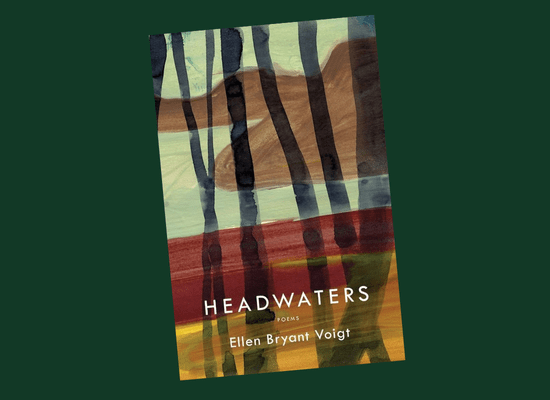
Headwaters, by Ellen Bryant Voigt, is a short collection of poetry that grounds her thoughts about far reaching topics into the natural world. Almost every poem is named after a different animal, with short, snappy titles that relate the animal as a metaphor for something more grand. Her writing style is unique for using no punctuation at all in her poems, and inconsistent or no capitalization as well, which gives readers many ways to read lines and interpret the poem, and thus, many meanings. While writing about nature, life and death, growing up, and even using religious metaphors, she is able to beautifully elucidate on the world around her.
Voigt uses strong language to describe the natural world around her in a way that truly makes it vivid to the readers. For example, in the poem “Chameleon,” she writes: “the lining of its mouth is red as it puts away / in three quick bites some kind of fly and then at its throat / a rosy translucent sac swells and subsides maybe peristaltic / pushing its meal forward or maybe preening for a mate or maybe / residual from the blooming hibiscus shrub or maybe learned from frogs” (Chameleon, 48). The language is truly vivid, with worlds like ‘peristaltic’ (relating to a wave-like motion of muscles that contract and relax in a tube-like organ) and translucent bringing the mouth of the chameleon to life. Other lines, like “fall’s technicolor beeches sumac sugar maple death / even the death of vegetation should never be / so beautiful,” evoke random but specific imagery to conjure up in one’s mind a very specific idea of fall (Privet Hedge, 14). Without the twisting language and uber specific wording, Voigt would not be able to create the same images in her poetry.
Voigt also writes about how life and death are cycles mirrored in nature in her poems. For me, the most vivid imagery was in the poem “Yearling”: “they slaughtered the hog the carcass / hoisted by its heels from the oak the planks across sawhorses holding / the hams the buckets catching the blood the shanks the organ meats / the chunks of white fat for biscuits the feet sunk in brine” (Yearling, 26). Writing about killing a pig on a farm, with references to fat, brine, shanks, and blood, truly made the slaughter of the pig vivid, despite my having never witnessed such a thing. The blood splatters and white chunks on hay remain vivid in my mind, a commendation to Voight and her writing. There is more writing that while vaguer or not as vivid, still references such ideas. Poems like “Oak” state “past seeing now past death too old for death” (Oak, 18) and poems like “Hog-Nosed Skunk” write “although my beloved won’t believe it / she just gives up she just gives up” (Hog-Nosed Skunk, 36). All of this in multiple poems help encompass the themes of Headwaters—of the world around us, beautiful and vivid and natural and cruel and full of death at the same time.
Her poems also have hints of other themes, such as growing up religious and learning to recognize herself and become a whole person. The poetry book has a definite coming of age vibe throughout the poems, with references to the Bible and her family. For example, in the poem “My Mother,” she states that to her mother, “the world / was an unplowed field a dress to be hemmed a scraped knee” (My Mother, 20). In another poem she references growing up, stating “my daughter at thirteen admired her tan her new body” (Noble Dog, 30). She even references the Bible in multiple instances, hinting at a religious upbringing, with lines like “it’s Adam and Eve except that Adam had no mother / no one who worried about that missing rib now incarnate / wearing white like a young birch” (Birch, 44) and “Ecclesiastes so the bereaved / can choose whether to believe / that death is a kind of hibernation” (Spring, 50). The latter relates back to the themes of life and death that permeate the novel. I think my favorite line is this—“the plural pronoun is a dangerous fiction the source / of so much unexpected loneliness” (Bear, 46). It is simply so beautiful, this idea that as you fall in love and go from “me” to “we” that it can be dangerous, that love and heartbreak can change your pronouns and how you think about yourself and every part in between. Love is complicated, but it is also a part of growing up.
Headwaters is ultimately a cyclical novel, about life and death, about nature, and about growing up. Everything that happens is meant to be, is simply a part of the world around us. Voigt discusses animal life cycles, nature, and what it was like to grow up multiple times, referencing everything from the awkwardness of hitting puberty to Eve being borne from the rib of Adam. This is my favorite of all the poetry books we have read this semester, and in the future, I would like to attempt to write poems with no punctuation and multiple meanings.
 Niharika Agrawal
Leave a comment