
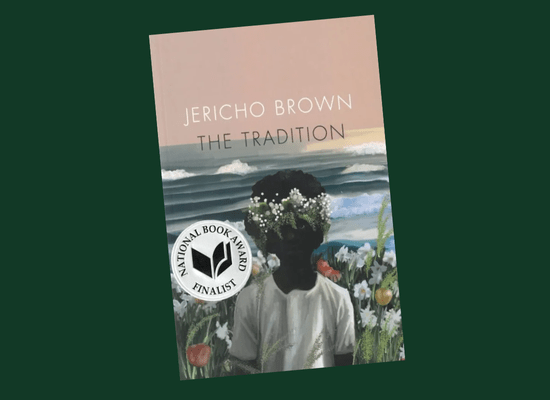
The Tradition, by Pulitzer Prize winning poet Jericho Brown, is my favorite collection of poetry from my advanced poetry class so far, and a beautiful exploration of terror, politics, mythology, history, and family trauma from the perspective of a black man. Brown is notable for creating the poetic form of a Duplex, which is a combination of a sonnet, ghazal, and blues, with indented couplets that repeat and rephrase previous sentences to give them new meaning. Brown starts each of his sections with a duplex (for the most part), each with meaningful lines that help wrap up the previous section or begin the next section: “A poem is a gesture toward home” (Duplex, 16) and “I don’t want to leave a messy corpse” (Duplex, 49) are particularly impactful.
A large part of The Tradition is an exploration of terror from the perspective of a black man in the 21st century. Brown explores police brutality in the poem “Bullet Points” when he writes “I trust the maggots / Who live beneath the floorboards / Of my house to do what they must / To any carcass more than I trust / An officer of the law of the land / To shut my eyes like a man” (Bullet Points, 16). The phrasing of carcass and maggots is particularly vivid, and truly drives home Brown’s mistrust and disillusionment with the police system. In another poem he explores the terror of mass shootings, writing “Ain’t that safe as any / Plan for parenthood / Mass shooting blues” (Entertainment Industry, 42). He describes flinching at the shootings in a movie due to previous experiences with shootings, and to me, that casual interaction truly drives home how horribly normalized shootings have become in the USA.
Going off of his themes on terror, he explores politics a bit outside of personal terror as well. My favorite mention of politics in the book comes in the poem “Hero”: “No one on Earth knows how many abortions happened / Before a woman risked her freedom by giving that risk a name, / By taking it to breast” (Hero, 11). The description of his mother hits particularly hard given politics right now, and I love the recognition that children can be risky not just biologically, but to personal freedom. Another line in the same poem reckons with the military industrial complex: “Gratitude is black— / Black as a hero returning from war to a country that banked on his death” (Hero, 11). It made me truly think about how so much of the military is built upon the guarantee of poor people of color signing up as a means of escaping poverty and paying for college, but possibly at the cost of their life. Jericho Brown has a particular gift for infusing every single line in his poetry with meaning, so much so that simple lines like the ones above in “Hero” are laden with meaning and history.
As a fan of Greek mythology, I adored how Brown referenced different Greek myths to reflect the different themes of terror and politics in The Tradition. The first poem in the book, titled “Ganymede,” referencing Zeus’s cupbearer, states: “When we look at myth / This way, nobody bothers saying / Rape. I mean, don’t you want God / To want you?” (Ganymede, 5). It’s a salient point that identifies how people retell myths to be more palatable or to focus on specific parts; did Ganymede fall in love with Zeus, or was he sold by his father? In another poem he discusses love using the Illiad, writing that “Romance is / An act / … Patroclus died because / He could not see / What he really was inside / His lover’s armor” (Trojan, 32). As a lover of the myth of Achilles and Patroclus, I loved this interpretation of the idea that Patroclus was so in love that he could not identify how cruel or war-hungry Achilles could be. This is even explored in Madeline Miller’s Song of Achilles, which is one of my favorite books. Brown is not shy about discussing sexual assault, as he does in his poem “Of the Swan,” which references the myth of Leda and the Swan. He says: “Immortality requires worship. / I was / The Lord’s opening on Earth / A woman / With feathers strewn round / My hide” (Of the Swan, 41). I found the idea of feathers strewn around a particularly vivid way to imagine the aftermath of poor Leda’s assault by Zeus, and Brown’s use of mythological references a vivid way to transcend the grounded and contemporary nature of his book into something broader.
Brown also discusses history, and how it affects people, especially his own relationship with it as a Black man who grew up in Louisiana. My favorite line in this theme is about his education, where he writes: “On the way to an American history exam / I almost passed. Redcoats. / Red blood cells. Red-bricked / Education I rode the bus to get” (The Microscopes, 8). Brown has a more complicated history with his relationship than many, especially considering his own family trauma, which he explores. In a poem pointedly titled “Good White People,” he says “You’ll have to forgive / My grandmother with her good / Hair and her good white people / And her certified good slap across / Your mouth.” (Good White People, 29). His parents were abusive; in “Hero” he mentions how his mother whipped him when he was younger, and how his ancestors were not always good people. He is blunt, saying “Your grandfather was a murderer. / I’m glad he’s dead / … He raped women / Who weren’t yet women” (The Long Way, 38). Brown’s honesty about his family demonstrates how in some ways, he uses his poetry to process his complicated emotions about his family and who they are. His opinion in history and its relationship to his trauma is best summed up like this: “We do not know the history / Of this nation in ourselves. We / Do not know the history of our- / Selves on this planet because / We do not have to know what / We believe we own” (Riddle, 28). This line rings honest; we believe we own the planet but know very little about it, and thus forget our history or wipe it out.
Jericho Brown’s The Tradition is my favorite poetry book I have read this semester. It is brutally honest about Brown’s trauma and complicated relationship with terror, history, and politics, and he grounds his far-reaching metaphors in real life events. I want to try writing more poems like Brown reckoning with my own history, and using mythology not as the focus of the poem, but as a framing device to help understand my own life.
 Niharika Agrawal
Leave a comment