
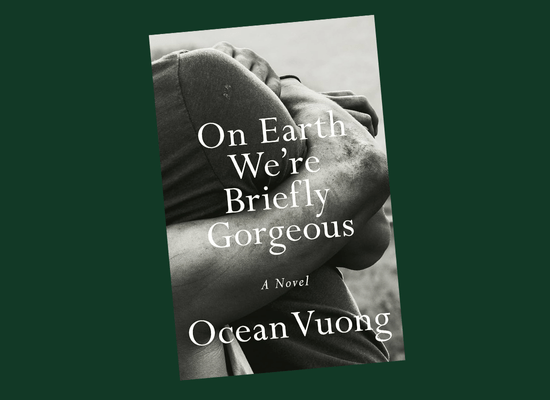
“If, relative to the history of our planet, an individual life is so short, a blink of an eye, as they say, then to be gorgeous, even from the day you’re born to the day you die, is to be gorgeous only briefly… Because the sunset, like survival, exists only on the verge of its own disappearing. To be gorgeous, you must first be seen, but to be seen allows you to be hunted.”
On Earth We’re Briefly Gorgeous, by Ocean Vuong
Summary
On Earth We’re Briefly Gorgeous is a letter from a son to a mother who cannot read. Written when the speaker, Little Dog, is in his late twenties, the letter unearths a family’s history that began before he was born — a history whose epicenter is rooted in Vietnam — and serves as a doorway into parts of his life his mother has never known, all of it leading to an unforgettable revelation. At once a witness to the fraught yet undeniable love between a single mother and her son, it is also a brutally honest exploration of race, class, and masculinity. Asking questions central to our American moment, immersed as we are in addiction, violence, and trauma, but undergirded by compassion and tenderness, On Earth We’re Briefly Gorgeous is as much about the power of telling one’s own story as it is about the obliterating silence of not being heard.
With stunning urgency and grace, Ocean Vuong writes of people caught between disparate worlds, and asks how we heal and rescue one another without forsaking who we are. The question of how to survive, and how to make of it a kind of joy, powers the most important debut novel of many years.
My Thoughts
I know that On Earth We’re Briefly Gorgeous has made a lot of people uncomfortable, but I loved it because it made me uncomfortable. It made me pause, made me think, truly put me into Ocean Vuong’s head as he processed years of trauma, not only his, but his grandmother and mother’s as well. This book to me, at it’s core, is about healing. This book is not going to appeal to everyone and it is not meant to. It reckons with domestic abuse, prostitution, the brutal history of the Vietnam War, racism, drug abuse, gay sexuality, and poverty. Vuong’s prose is gorgeous, full of beautiful metaphors and drawing relationships between seemingly unrelated things. He has a gift for finding beauty in the mundane.The language is incredibly poetic, jumping from prose to something that feels almost like prose poetry. Language is, in some ways, the main point of the book. The narrator, Little Dog, spends a lot of time translating his Vietnamese life into American. He translates for his mother and grandmother, who do not speak English and are illiterate, and he translates himself, a dark skinned Vietnamese boy born in Ho Chi Minh (formerly Saigon), to become more palatable in Hartford, Connecticut.
The novel is structured in the form of letters from Little Dog to his mother, who cannot read. She is not meant to read them. The relationship between Little Dog and his mother is strained, once physically abusive, and emotionally distant, driven by a lifetimes of traumas. The letters are, in some ways, everything Little Dog wishes he could say to his mother but cannot. Throughout the book, with each word and letter, Little Dog not only begins to understand his own past better, but the traumas of his mother. He begins to understand where she is coming from and why she is the way she is. For example, she is forced by her abusive ex-husband, who for most of Little Dog’s childhood is in jail, into getting an abortion, and describes it as: they “scraped my baby out of me, like seeds from a papaya” (pg 125). This description was so vivid I had to pause for a second to just take it in, to be honest. It’s the best description in the entire book, in my opinion, for the emotions in evokes.
There is a lot of trauma in this book. His grandmother ran from an arranged marriage with a man much older than her and had to make a living as a prostitute for American soldiers to support her first daughter, Little Dog’s aunt Mai. She has her second daughter, Rose, with an American soldier who she marries but who ultimately does not stay with her. She does not even have her own name, and picks her own after running from her first husband. I found this scene so poignant and beautiful, his grandmother picking the name Lam—Lily—as a metaphor for rebirth, like a flower in bloom. Vuong finds incredible beauty in this act, writing: “all this time i told myself we were born from war—but i was wrong, ma. we were born from beauty. let no one mistake us for the fruit of violence—but that violence, having passed through the fruit, failed to spoil it” (pg 207). This was one of the most beautiful things I have ever heard, especially as I begin to understand my own Indian heritage and history. However, it is also very dark. The story is hard to get through at times, and I would not recommend reading in one sitting.
The narrative is incredibly restless. It is full of vignettes from Little Dog’s past, often haunted by specific memories, and at times jumps between them. Vuong explores the biracial past of Tiger Woods (who is part Vietnamese) and the legacy he left on golf in the same breath that he explores his burgeoning sexuality with a white boy named Trevor, who he meets while working on a tobacco farm with migrant workers from South and Central America. It has no strict chronology, through certain elements, like the relationship between Little Dog and Trevor, move in a generally linear formation, with a lot of loops along the way. However, at times his restlessness is a detriment to the strength of Vuong’s novel. It takes a while to get into the book because you cannot really tell where it is going near the beginning, or what the point of each part of the story is. The narrator suddenly begins talking about Tiger Woods, interspersing facts with his own life, and you aren’t entirely sure what the parallels mean. His grandmother is dying of cancer, the descriptions grotesque and horrifying as her feet turn black, and it all of a sudden jumps to the first time Little Dog had sex with Trevor. He draws connections, sure, but they feel a bit forced, the cancer and sex relationship especially. It was honestly jarring, reading it, especially since many of his other connections between stories are a lot smoother. This most likely comes from Vuong’s background in poetry, where the connections do not have to be drawn as tightly.
Overall, this is an absolutely amazing novel and I would definitely recommend it, but it is not a light book.
Review: ★ ★ ★ ★ ☆
 Niharika Agrawal
Leave a comment