
“The memoir is, at its core, an act of resurrection. Memoirists recreate the past, reconstruct dialogue. They summon meaning from events that have long been dormant. They braid the clays of memory and essay and fact and perception together, smash them into a ball, roll them at. They manipulate time; resuscitate the dead. They put themselves, and others, into necessary context.”
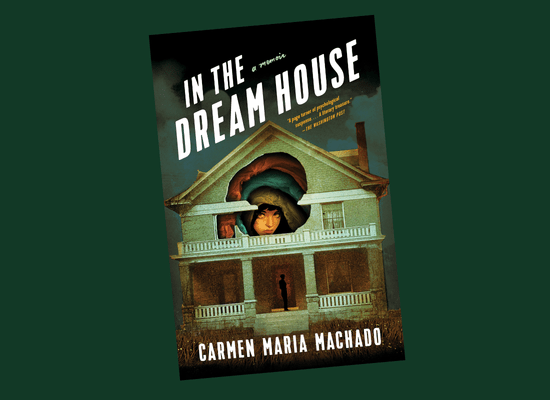
In the Dream House, by Carmen Maria Machado
Summary
In the Dream House is Carmen Maria Machado’s engrossing and wildly innovative account of a relationship gone bad, and a bold dissection of the mechanisms and cultural representations of psychological abuse. Tracing the full arc of a harrowing relationship with a charismatic but volatile woman, Machado struggles to make sense of how what happened to her shaped the person she was becoming.
And it’s that struggle that gives the book its original structure: each chapter is driven by its own narrative trope―the haunted house, erotica, the bildungsroman, classic horror themes―through which Machado holds the events up to the light and examines them from different angles. She looks back at her religious adolescence, unpacks the stereotype of lesbian relationships as safe and utopian, and widens the view with essayistic explorations of the history and reality of abuse in queer relationships.
Machado’s dire narrative is leavened with her characteristic wit, playfulness, and openness to inquiry. She casts a critical eye over legal proceedings, fairy tales, Star Trek, and Disney villains, as well as iconic works of film and fiction. The result is a wrenching, riveting book that explodes our ideas about what a memoir can do and be. In this extraordinarily candid and radically inventive memoir, Machado tackles a dark and difficult subject with wit, inventiveness and an inquiring spirit, as she uses a series of narrative tropes to create an entirely unique piece of work which is destined to become an instant classic.
My Thoughts
This book changed my brain chemistry and I’m not even joking about that. It’s the first memoir I’ve read and it has set an incredibly high standard for all others. Each chapter is unique, titled “Dream House as ____” with a different narrative trope to go along with it. The book is rife with footnotes; Machado references not only dictionaries of tropes, but research into literature on queer abuse in order to reference statistics and stories, and to give some context to her own narrative in some chapters. The concept of a memoir is deeply personal. The authors pry open their own life and give you a tour of their mind, picking at the scabs of their trauma until they bleed flesh for our viewing pleasure. Machado does all this and more, somehow putting to page the inexpressable horror of psychological abuse. The chapters are unique—she does not just use traditional narrative tropes like the “Unreliable Narrator” or the “Road Trip” but has a trippy “Choose Your Own Adventure” chapter where she dives into how helpless her actions at the time of her relationship felt, how there was never any option but the actions she took but how she wished she had done something different. This particular chapter is an exercise in futility and it is heartbreaking. She speaks in most of the book using first person, but shifts to second person to address both a younger Machado and also the audience. Through this, we in some ways put ourselves in the shoes of a younger Carmen Maria Machado, eager to see the world, unknowing of the horrors of psychological abuse.
I loved the way that she discussed the outward impacts of abuse—what abuse means in the queer community, for example. I loved a footnote that noted that while abuse in heterosexual relationships is often seen as a sign of misogyny, abuse in homosexual relationships is considered a sign of homophobia. She didn’t expand, the thought unfinished, but it stuck with me. Queer abuse is often not documented; the few cases that Machado discusses more often than not had juries looking to paint people of color as the abuser, or be unable to see an abuser when both parties were women. In many ways, Machado is one of the first to begin creating an archive into the unexplored world of queer abuse. She begs us to understand that to deny such a thing is to deny the queer community their humanity. Every LGBTQ+ person is human, and thus, every single one of them is capable of the same cruelty and suffering as their heterosexual counterparts. She is very aware of the societal expectations of what queer relationships should look like, spills her inner fears that by being a victim of abuse, she is hurting her entire community in some way. After all, the LGBTQ+ community fought hard for marriage equality; shouldn’t their relationships work? This shadow of societal expectation hovers
Her emotions are raw across the pages, giving us a view into every insult, every scream, every cruelty from her former partner. She urges us to sit with it, to understand that “This is not normal. This is not normal. This is not normal.” The repetition had my heart in my throat, as she tries to convince not just the readers of this fact, but herself. Her writing is lyrical and exquisite, verging into prose at times. This book will draw out your emotions not just if you have never been in a relationship before, but if you have survived an abusive relationship, in my opinion. My favorite part was the chapters where she discussed her understanding of psychological abuse after leaving the relationship. She struggled to understand where the abuse began and ended, when something changed. It was never physical, there were no marks; at times, Machado shamefully admits that she wishes her ex-partner, the “blonde”, had hit her, if only so Machado had proof outside of her own mind that something was wrong. Let’s be clear: you’re not getting the nitty gritty details of what Machado’s house looked like, or how she made money, or when she went grocery shopping. The memoir is focused entirely on her emotions and her previous relationship.
Ultimately, this book is a must read. You don’t have to be queer to understand that this is a literary masterpiece of creative nonfiction.
Review: ⚫ ⚫ ⚫ ⚫ ⚫
 Niharika Agrawal
Leave a comment