
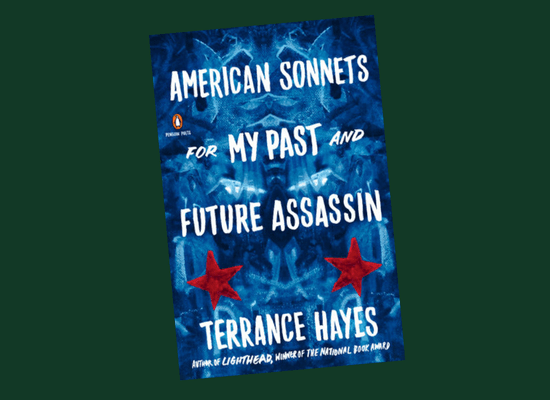
American Sonnets For My Past And Future Assassin is a recent book of award-winning poetry by author Terrance Hayes that deals with themes of racial trauma, identity, love, and what it means to be American. He is very explicit at times, using language that references genitalia, or slurs like the n-word, but they have their place in the seventy sonnets that make up this book. His book is closely intertwined with American politics and the history of slavery, and was written in the first two hundred days of the Trump presidency (the first one), and thus shaped by that experience. He starts multiple sonnets with the line “But there was never a black male hysteria” to critique the cultural framing of Black men as inherently deserving of hysteria or fear, and try to recontextualize their place in society and history.
Hayes spends multiple moments in the book directly addressing the “assassin” and actively talking to “America,” with both of those generally representing oppressive and racist systems of power and the people who uphold them. A line I thought was particularly powerful was “we relate the way the descendants / Of the raped relate to the descendants of their rapists. / May your restlessness come at last to rest, constituents / Of Midas. I wish you the opposite of what Neruda said / Of lemons. May all the gold you touch burn, rot & rust” (Sonnet 26, pg 32). His phrasing “constituents of Midas” refers to people who worship capitalism and money above all else, even human lives or well being, and it is quite evocative. He references money again a few sonnets later, stating “I carry money bearing / The face of my assassins” (Sonnet 32, pg 40). In this particular case “assassins” refer to the Founding Fathers, many of whom were slave owners—George Washington, for example. However, he also takes care to show empathy towards the assassin who may have been radicalized, who might be a soldier, or a cop: “In this we may be alike, Assassin, you & me: we believe / We want what’s best for humanity” (Sonnet 42, pg 50). I thought an incredibly powerful line was “I ain’t mad at you / Assassin. It’s not the bad people who are brave, I fear, it’s the good people who are afraid” (Sonnet 53, pg 63). This rings especially true in today’s political climate, especially the idea of the good people being afraid.
The political overtones of his writing continue with his struggle to understand American identity, and what it means to be Black in America. He asks “Are you not the color of this country’s current threat / Advisory?” (Sonnet 6, pg 10). Written back in 2019, he had no idea how true this would ring come the 2020 BLM protests. In another sonnet he states “America’s struggle with itself / Has always had people like me at the heart of it. You can’t / Grasp your own hustle, your blackness” (Sonnet 30, pg 38). It is a very astute way of pointing out that Black Americans have shaped culture for a long time, and even when their ideas become more mainstream or normalized and people forget their roots, they come from Black culture. He asks about democracy in another poem, stating “The umpteenth slump / In our humming democracy, a bumble bureaucracy / With teeny tiny wings too small for its rumpled, / Dumpling of a body” (Sonnet 40, pg 48). This poem has incredibly strong sonic imagery, where everything rhymes and flows together, and Hayes uses words that don’t exist to create certain sounds to get his idea across. In this case, it is the idea that our democracy is slumping, fumbling, bumbling. I think it is very succinctly put when he says “This country is mine as much as an orphan’s house is his” (Sonnet 61, pg 73). What does it mean for Hayes and other Black Americans to be born in America, grow up and America, and not have America accept them?
Hayes doesn’t just thematically touch upon American identity, but upon the history of racial trauma and oppression in America. In one poem, he identifies the names of people responsible for the assassinations and murders of innocent black men or revolutionaries—John Wilkes Booth, who killed Abraham Lincoln, and Roy Bryant and J.W. Milan, who murdered Emmet Till and got away with it—stating “The names alive are like the names in the graves” (Sonnet 8, pg 12). In another poem he explicitly talks about the history of lynchings in America, never more of a topic of consideration than now, when not a few weeks ago, a Black student was found hung on his college campus and the university tried to cover it up. He says “The skin is replaced / By a cloak of fire. Sometimes it is river or rainwater / That cloaks the bone. Sometimes we lie on the roadside / In bushels of knotted roots, flowers & thorns until our body / Is found… Still, I speak for the dead. You will never assassinate my ghosts” (Sonnet 13, pg 17). It references all the methods by which Black Americans have been lynched and assassinated: hanging, burning, water, their bodies even being tossed to the sides of the road, and yet Hayes brings their ghosts to life and speaks for them.
Hayes’ book is not all political, however; he also talks about day-to-day life and the things that come with it, like love. In one poem he addresses other men, telling them “You are lonely because you could never unhitch / Your mother’s terrifying radiant woe” (Sonnet 28, pg 34). It reminds me of the discourse about men who are lonely because of how overbearing their mothers can be to any women they bring home, and relates to a line in another poem: “You are the scent of rot at the heart / Of love-making” (Sonnet 4, pg 8). Something about the imagery of rot in this line is incredibly visceral. In another poem, he asks the readers to define life, referencing poems that also talk about life like Rainer Maria Rilke’s sonnet “Archaic Torso of Apollo,” which I have read and highly recommend. He says “I live a life / That burns a hole through life, that leaves a scar for life, / That makes me weep for another life. Define life” (Sonnet 29, pg 37). Upon further consideration, I do not know if I can define life like he asks the people reading the book to do. He references Greek mythology again in a poem about love, saying “I believe / Eurydice is actually the poet, not Orpheus. Her muse / Has his back to her with his ear bent to his own heart. / As if what you learn making love to yourself matters / More than what you learn when loving someone else” (Sonnet 49, pg 59). While I think that it is important to know oneself before they attempt to know and love someone else, it is also true that we learn far more from our community and the people around us than we do from being alone. I loved the framing of Eurydice being the poet, personally.
American Sonnets For My Past And Future Assassin is overall an incredible book of poetry that deals with real and pressing political and racial issues facing us today. The sonnet structure doesn’t feel forced, but instead natural to his writing, and his choice to title every single sonnet the same thing, “American Sonnet For My Past And Future Assassin,” makes the poems blend together a bit and the themes feel more connected. If I had to pull anything from this book, I would want to try writing a poem that mimics the sonic imagery Hayes uses in some poems, with the sound and rhythm of the poem when read aloud pushing the message across just as much as the words.
 Niharika Agrawal
Leave a comment