
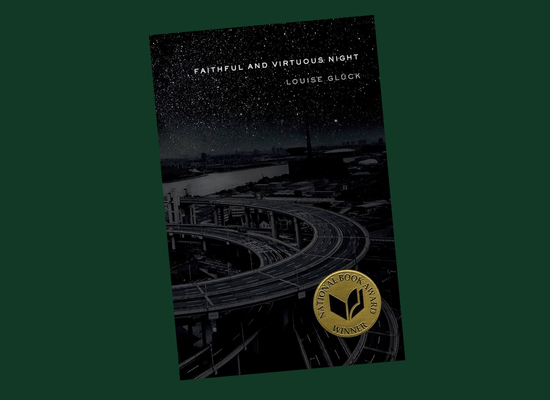
Faithful and Virtuous Night, by Louise Glück, is a National Book Award Winner and collection of poetry that at times borders on prose when discussing themes of death, time, aging, solitude, and memory. It is very different from other collections of poetry I have read, with multiple prose poems, and certain poems taking up anywhere from 2-5 pages as they intersperse long snippets of memory and reflections upon said memories. Many of the themes are abstract, centered not around a specific poem, but bridging multiple poems to communicate the concept.
She spends much of the book ruminating on life itself, asking “should we have a purpose” (Parable, 3). Much of the book is centered around this idea of human purpose in relation to deaths of loved ones, aging, and memory. It is clear that Glück is writing this near the end of a long, storied career, looking back on her life. In another poem, she states that “all human beings are divided / into those who wish to move forward / and those who wish to go back” (Faithful and Virtuous Night, 15). It is unsure which one Glück is; I personally know that while I most of the time wish to go back, I want to become one of those people who wishes to move forward. It is not something I really thought of in that way until I read this poem—thus, the power of poetry.
She spends other poems reflecting on aging and time, especially with naturalistic imagery. One of my favorite lines is at the beginning: “And snow fell upon us, and wind blew, / which in time abated—where the snow had been, many flowers appeared, / and where the stars had shone, the sun rose over the tree line / so that we had shadows again; many times this happened” (Parable, 3). It truly reflects the cyclical nature of life and the world, and how things both change and stay the same. In the same poem is remarks “ah, behold how we have aged” (Parable, 3) and a few pages later, “these farewells, I said, are the way of things” (An Adventure, 5). It is clear that in her life, Glück has said goodbye to many people; her parents, her previous spouses, even her belongings, during an unfortunate housefire, yet she remarks on it all in a rather blase way, simply stating that that is how the world goes. Near the end of the book, she asks readers to ponder “if the essence of time is change, / how can anything become nothing?” (The Story of a Day, 61). I don’t believe I have an answer to this; I don’t like to ruminate on the idea of the world around me becoming nothing and dissolving, because it makes everything feel temporary, and scary, but nevertheless time means change. Whether that change is good or bad is up to us, and I cannot help but work towards a good change. This is big picture thinking, however; Glück’s poem is about a single day—changes can happen both over the course of a day and a lifetime. Again she reflects on the cyclical nature of life and change. This connects to her ruminations on death as well, with lines such as “Somewhere, in the far backward reaches of time, / my mother and father / were embarking on their last journey” (Faithful and Virtuous Night, 12)
It is clear that Glück, publishing this in 2012 at the age of around 68, has lived a long life. She writes the book as though is about to die, asking “We had escaped from death— / or was this the view from the precipice?” (An Adventure, 6). There is a temporary nature to many of her reflections, wondering if this will be the last day or not. However, almost paradoxically to me, she doesn’t seem to view death itself as much of a change. She writes “I was, you will understand, entering the kingdom of death, / though why this landscape was so conventional / I could not say” (An Adventure, 5). The idea that the kingdom of death would be almost identical or similar to the world we live in is a fascinating one—I actually recently saw this topic explored in R.F. Kuang’s new book Katabasis, about two graduate students who go to hell to rescue their thesis advisor. Despite the idea that perhaps death is similar to life, or perhaps because of it, she argues that we continue to change even in death. “Perhaps the two great moments will collide / and I will see my selves meet, coming and going— / Of course, much of my original self / is already dead, so a ghost would be forced / to embrace a mutilation” (Approach of the Horizon, 49). I love the idea that not only do we change in death, but that much of our original self is already dead. Glück ultimately likens the process of living a life and evolving to a kind of constant death, wherein by changing and becoming who we are meant to be, we kill our old self in the process, and thus each of us is trailed by corpses of our youth. Or perhaps it is the idea that the only remnant of our old selves left is in our memories, thus connecting to Glück’s focus on memory in the book.
In order to invoke memories of the past, Glück sets readers in the memory using imagery of nature. For example, she writes “Smell the air. That is the smell of the white pine, / most intense when the wind blows through it / and the sound it makes equally strange, / like the sound of the wind in a movie” (The Past, pg 7). The white pine is incredibly vivid in this poem. She specifically says “Nature / reflecting art: something to that effect”, which is absolutely true (The Sword in the Stone, 41). By evoking naturalistic imagery, Glück uses it to set readers within very specific memories and bring those memories to life; memories that reflect people and places that ultimately do not exist anymore, because they have been changed. The white pine in the wind as Glück experienced it will never truly exist again, not in that exact same form. The only true proof of the existence, the only permanence, is in Glück’s writing. Thus nature not only reflects art but helps inform art.
Glück’s focus on the cyclical nature of life is reflected in her constant use of the infinity motif. She writes “infinite endings. / Or perhaps, once one begins, / there are only endings”, again reflecting the idea of constant change being cyclical, and creating more and more endings and deaths of our old selves (Faithful and Virtuous Night, 17). She reflects on her legacy as well: “I have no heirs / in the sense that I have nothing of substance / to leave behind” (Approach of the Horizon, 51). This line struck me, since society constantly tells us that without having kids, we have no legacy. Glück ruminates on this, but I would argue that her poetry is her legacy, and possibly a more powerful one than her family. I particularly loved the line “writing the words THE END on a piece of paper before he began his stories” (The Open Window, 44). This had the most powerful effect on me in terms of summoning motifs of infinity and cycles of life. In a way, our story’s end is written the moment we are born, and Glück really draws upon that.
Faithful and Virtuous Night from Louise Glück is ultimately a stupendous book of poetry, and I fully understand why it has won so many awards. The more I thought about the book the more I liked it, though it is not my favorite that we have read. While the themes are beautiful, I don’t think I would reread it. Drawing from Glück’s writing, I would want to experiment more with prose poetry; she has quite a few prose poems in the book, and her lines are very long. My favorite prose poem was “Forbidden Music”, which reminded me a lot about themes of censorship and the power of music to evoke emotion, and how music has been used in rebellions both fictional and nonfictional.
 Niharika Agrawal
Leave a comment