
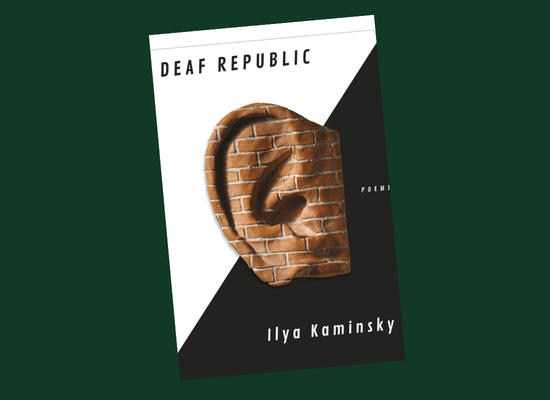
Deaf Republic, by Ilya Kaminsky, is one of the most unique collections of poetry I have read in a long while. Straddling the border between fiction, poetry, and prose, it uses poems to tell the story of a time of political unrest in occupied territory, presumably drawing upon his own history of being born in Odessa in the former USSR before he became an American citizen. It is a hard book to talk about because the poems truly blend into one another in a linear fashion; they could not be ordered any other way, because the book has a plot. Spoilers: the first part follows a married couple, Sonya and Alfonso, who watch a deaf boy be shot by soldiers, and then over the course of the book, have their daughter, Anushka, and are both arrested and murdered. The second part follows Momma Galya, who adopts Anushka as her own while puppeteering insurgency, and is also murdered by the end. This is a very stark, short summary of the book, but it is so much more, touching upon themes of love, death, the body, war, and silence.
A key part of the book is that the entire town chooses to go deaf and stop hearing the soldiers after the death of the deaf boy at the beginning of the book, as an act of protest, and by doing so, silence becomes its own character within the book. A key line is “observe this moment / —how it convulses—”, and it is repeated multiple times in the book when emphasizing a key moment (As Soldiers March, Alfonso Covers the Boy’s Face with a Newspaper, 12). The usage of ‘convulses’ feels incredibly literal and human, harkening back to the boy who was just shot dead, who didn’t even have time to convulse or feel pain. Another phrase repeated multiple times to great effect is “what is a [child/man/woman]? / A quiet between two bombardments” (Question). The poem “Question” is repeated three times throughout the book, each time asking a different question, and those two lines make up the entire poem. With another line, “something silent in us strengthens,” the author is able to hone in on the rebellious power of silence when it is unexpected or goes against the norm in a way that to me, mirrored ideas of nonviolent protest popularized by men like Mahatma Gandhi and Martin Luther King Jr. (Deafness, an Insurgency, Begins, 14). Silence very much feels loud in the book: the phrase “quiet hisses like a match dropped in water” reflects this (Arrival, 26). It is a part of a prose poem which I enjoyed, and a very unique metaphor. I am unsure how to describe the sound of a match dropped in water but it felt like fitting. Silence is not entirely about strength, however. In another poem, the line “no one stands up. Our silence stands up for us” is used in a far more ambiguous context—is silence resistance, or is it a testament to how war and occupation divide people, and how the townspeople won’t even stand up for their fellow men (The Townspeople Watch Them Take Alfonso, 32). Does silence represent cowardice, survival, or strength? The ambiguity of how it can be interpreted allows readers to really think about what it means.
While silence is a strong motif in Deaf Republic, it is set during a war, which permeates all the poems. The very first poem in the book states “And when they bombed other people’s houses, we / protested / but not rough, we opposed them but not / enough” (We Lived Happily during the War, 3). This really struck me, the idea of being a bystander from the start. It reminded me of Martin Niemöller’s poem “First They Came For…”, where no one can speak for you because they have all been taken while you were silent. It also reminds me of what is happening today with ICE, and immigrants being detained or disappeared, including thousands of the inmates in Alligator Alcatraz, who vanished when the detention center closed. This book remains incredibly relevant today, which is kind of sad, because we would like to believe we have moved past this. The presence of bystanders in war is a repeated theme. Another poem asks “At the trial of God, we will ask: why did you allow all this? / And the answer will be an echo: why did you allow all this?” (A City like a Guillotine Shivers on Its Way to the Neck, 40). This again focuses on active vs passive resistance, and on how we have as much of a responsibility as any God to stop the atrocities occurring in front of us.
The human body plays a role in the poetry as well, both a repeated focus and a way of bringing life to the characters. The most visceral description for me was in the title of the poem “That Map of Bone and Opened Valves” on page 16, which was used to describe the face of a young boy who was just shot in the face and murdered. The idea of his face being nothing but this map was so vivid and well-done; this is how good metaphors in poetry are executed. In another poem, the soldiers who are occupying the town are described “as if they are men / and not just souls on crutches of bone” (Search Patrols, 63). I think it is fascinating that they are ‘not men’ in this poem, but ‘souls on crutches of bone’. The use of crutches to me brings about ideas of disability, similar to the deaf boy, which mirrors Kaminsky’s focus on disability as strength. It also evokes a certain idea of lost humanity that comes with complying with war crimes, as though they ceased to be men the moment they occupied a town and began disappearing and murdering its civilians. The idea that these soldiers are missing something and searching for it in violence is referred to in another poem: “Body, they blame you for all things and they / seek in the body what does not live in the body” (Firing Squad, 64). The idea that we both blame the body for violence but also speak out something that does not live in the body—perhaps silence, peace, more violence—really speaks to me. Kaminsky is incredibly adept at using the setting of the war to drill down into human nature.
While a lot of the themes in Deaf Republic are rather dark, Kaminsky also ensures that he focuses on the lighter aspects within the war: love. The main couple of the first part of the book, Sonya and Alfonso, have multiple poems as a testament to their love, and the most touching line for me was “You can fuck / anyone—but with whom can you sit / in water?” (While the Child Sleeps, Sonya Undresses, 29). The sheer intimacy of the two just sitting in a bath together, and the comfort of knowing one another that well is truly beautiful. Later on in the book, when Sonya is dead, her red socks become a repeated motif of Alfonso’s everlasting love for Sonya. He is grieving his wife and is now a widower, but he wears her red socks everywhere, so much so that the townspeople identify them as his red socks, not realizing that they are Sonya’s. It is not just romantic love, but familial love that is focused on. Sonya gives birth near the beginning of the book to a little baby, Anushka, who after the death of her parents, is taken in by Momma Galya, who proclaims: “Anushka, your pajamas— / they are the final meanings of my life” (The Little Bundles, 58). There is strength of the newborn Anushka as a sign of innocence and love, but also as motivation for our main characters. So much of what Galya does in the second half is for Anushka, in the hopes of protecting her from the war and keeping her innocent.
Ilya Kaminsky’s Deaf Republic is one of the best books of poetry I’ve read in a long time, partially because it reads a bit like a novel. The only loose thread at the end is the fate of Anushka, who after the death of all the main characters, sort of disappears. I think that this fits with the book however; one last loss of innocence, mirroring the start of the book and the death of the other child. I also think that the structure of the book is fascinating: having read a lot of old Greek plays, I noticed that the townspeople act a bit like a Greek Chorus. If I had to take inspiration from the book, it would be in how Kaminsky’s book is so thematically cohesive and tight. He was able to have poems like “Question” repeat multiple times, only change a single word, and still have each poem hit entirely differently.
 Niharika Agrawal
Leave a comment