
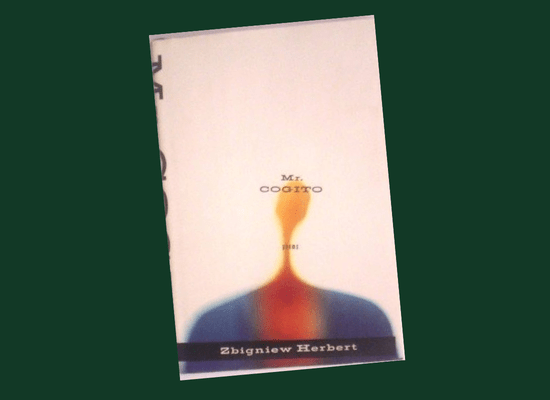
Mr. Cogito, published in 1974 by Polish poet Zbigniew Herbert and later translated by John Carpenter and Bogdana Carpenter, is a very unique book of poetry. For starters, this particular translation is out of print, making it hard to get your hands on, but it is also unique in terms of style. Despite being a much older book of poetry in terms of optics, the style feels very modern: it is written in free-verse with little to no punctuation. Herbert references grammatical concepts a lot, like “onomotapeia” and “syntax”, making this in part a book of poems about writing poetry. He also makes a lot of classical illusions that deepen the poems and demonstrate the breadth of his knowledge: The Upanishads, Homer, and Caligula, for example. He even has a poem called “History of the Minotaur” on page 37, where he retells the ancient Greek myth of the Minotaur, but the Minotaur is only a regular boy, albeit a bit dumb. Drawing on the history of Poland and his time resisting the Nazis, and the later resisting communism, Herbert infuses those experiences into the book.
Before talking about the themes, I have to touch on the language; the way he discusses nature is gorgeous. He has a poem called entirely about autumn: “the air grows bald / last grands if honey first reds of maples / a fox killed on a field space reverberating with shots… a high moon rises accept the glaze over your eyes” (Late Autumnal Poem Of Mr Cogito Destined For Women’s Magazines, 23). There is no punctuation between any of the phrases so they blend into each other, forcing you to take time when you read the poem. It is also a little bit meta because the eyes of the reader glaze a bit, mirroring the glaze from the moon, when reading the poem due to the structure—a prose poem with no punctuation, technically phrased as one sentence. He strongly personifies nature in his poetry, bringing the world to life: “a / goblet dropped on the parquet floor gives / an abrupt shriek like a glass bird, and a / house which has been set on fire talks / with the loquacious language of flames / with the language of a breathless epic / poet” (To Take Objects Out, 24). The phrasing “loquacious language of flames” was striking, speaking to how alive fire can be.
Mr Cogito focuses a lot on identity; specifically the main character, Mr Cogito, figuring out who he is. Part of his exploration is into heroism, and what it means in the real world. He asks what is “the place of the hero / in a system of necessities, to reconcile the notions of existence and / fate that contradict each other” (Old Prometheus, 38). Heroes can exist in fiction, but in real life, necessity often gets in the way. People in war have to do what is necessary, not always what is right. In another poem, he asks about “the idea of invariability” and “the loss of one’s own nature”, focusing on the struggle between knowing who you are and who you are slowly changing into, like “a stone / with sandstone” (Sense of Identity, 9). Herbert, who uses Mr Cogito as a sort of character or stand-in for himself, doesn’t want to be a hero. He claims that “never / was he attracted by the role / of the hero of the escape… Mr Cogito / would like to be the intermediary of freedom … to trust the heart / the pure impulse of sympathy… he accepts an inferior role / he won’t inhabit history” (Mr Cogito’s Game, 55-56). I find this perspective fascinating, and it reminds me of a book I read recently, which focused not on the heroes of war, but on the people who help them and ultimately get ignored by history, despite their sacrifices. There are so many people who fought in wars that will not be remembered as their heroes, but whose contributions were vital nevertheless, and I found that a bit sad, so the idea that Herbert finds this appealing is rather beautiful to me. At least in this role history won’t mistake him for someone he is not, or attribute things he didn’t do to him, or pick his roles apart.
This particular theme relates strongly to other themes of historical trauma in the poetry collection. Sometimes it is explicitly talking about war crimes: “didn’t he cry out / as he was dragged across the courtyard / didn’t he fall / pleading on his knees / when they aimed /at the great star on his chest” (Sometimes Mr Cogito Receives Strange Letters, 49). It is visceral, but also focuses on his bravery. More often, he focuses on the idea of abandoned history, and war wiping out said history, or moments you remember. In a poem about a museum he writes “they abandoned history and entered the laziness of a display-case / they lie in a glass tomb” (Those Who Lost, 27). It feels related to his idea of not wanting to be remembered by history, in case he ends up in a display case, a glass tomb. In another poem he says “If I went back there / probably I wouldn’t find / even a shadow from my house… nor a single thing that is ours” (Mr Cogito Thinks Of Returning To The City Where He Was Born, 10). This creates a sense of sadness—Mr Cogito returning home to find that his memories have been erased, and there is no physical evidence that his memories were real. It creates a sense of uncertainty; did it ever exist? Is he making it up?
Other themes Herbert explores are themes of compassion, the strength of the mind, and death, all of which relate to the themes above as well. In one poem he says “there are two many of them / the numeral zero at the end / changes them into an abstraction / a subject for meditation: / the arithmetic of compassion” (Mr Cogito Reads The Newspaper, 16). This strikes me as true even in today’s politics: why is it that 20 people dead is sad, but 200 is a tragedy? What does that extra 0 add? Shouldn’t 2 people dead still be a tragedy? Herbert has no answers, but simply asks readers to ponder on the arithmetic of compassion: at what point do we hit enough deaths for it to become abstract enough to be worthy of sympathy, but not enough for us to do anything about it? About the mind he says “the popular expression overestimates the movement of thoughts / most of them / stand motionless / in the middle of a dull landscape / of ashy hills” (Mr Cogito And The Movement Of Thoughts, 17). It’s contradictory to the idea that thoughts are always racing, but to me it seems real; I know that in my brain I always have multiple streams of thought going at once, but in comparison, everyone else’s brains seem so quiet, so much easier to focus. His adjective use is pointed, with ‘dull landscape’ and ‘ashy hills’ evoking a barren landscape. Both of these themes relate to the cyclical feeling of Mr Cogito, the idea that there are cycles of violence, of the mind, that are hard to grasp and easy to repeat. He says “there is / nothing / beyond birth and death nothing only birth and death” (Sequoia, 26).
Mr Cogito by Zbigniew Herbert is a beautiful collection of poetry that touches upon a lot of themes: death, the mind, identity, historical trauma, and more, all interspersed with vivid imagery that evokes the natural world. It is written in a style similar to antipoetry, with very little capitalization or punctuation, and I want to try writing more poetry like his with less structure to it, and more jumping around. He has a way in which he connects disparate images in a way that seems natural.
 Niharika Agrawal
Leave a comment