
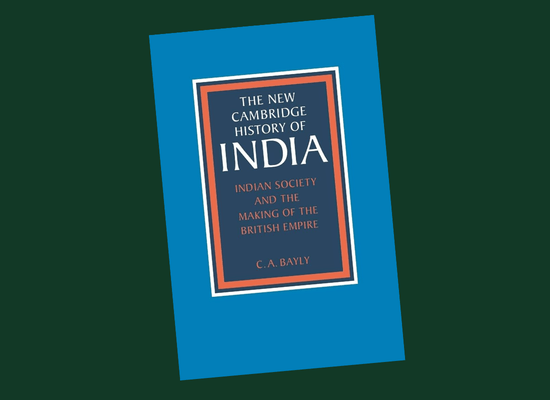
C.A. Bayly’s book Indian Society and the Making of the British Empire is a unique academic work in that it focuses entirely on dissecting the pre-colonial era of Indian history and how exactly the British came to power in India. He focuses not only on the historiography of the period, but is incredibly detailed in his analysis, with multiple examples for each of his arguments. He starts, uniquely, before the British arrived in India, to set the scene and to make very clear that the South Asian subcontinent was a flourishing collection of cultures before colonialism, and to push against the biased narrative that India was a blank, uncivilized slate for the British to shape as they pleased. The biggest strength of the book is its detailed analysis, but this is also a weakness: this novel is not written for the average lay-person, but for someone with preexisting knowledge of that period of history. It is written for a historically informed audience, and as a result, Bayly skims over certain important topics in favor of deep analysis of others.
The main argument Bayly makes in the book is that rather than the myth of anarchy and the fall of the Mughal Empire explaining how the British took over, it was the process of change that started during Mughal Expansion that undermined the very fabric of the Mughal Empire, and the British took advantage of the pre-existing forces of change to establish legitimacy in India. He argues further that Indians were “active agents and not simply passive bystanders and victims in the creation of colonial India” (Bayly 5). He uses a lot of evidence to back his argument up, with different Indian kingdoms having their own mini narratives within the book as to how they interacted with the British in the pre-colonial era. Unlike other authors, he does not treat all these actors as one monolith, or assume that India was one empty swath that the British shaped, but writes about how India was full of dozens of cultures—Maratha kingdoms, the Rajputs, Sikh, Telugu warriors in the Deccan, Afghan sultanates, Muslim kingdoms, and local powers—all of whom interacted differently with the British, to aid or resist them. Why were the British attracted to India in the first place? Bayly explains that while “Indian politics and trade were seen as irremediably disorganised and self-destructive, from another perspective the British were drawn into internal trade and politics precisely because they were buoyant, volatile and immensely profitable” (Bayly 46). They were attracted by the lure of rapid profits, and then were encouraged to intervene by indigenous social conflicts that came along with the dynamic period of change that was occurring at the time.
Bayly does not shy away from interrogating the differentiated and hierarchical nature of power in pre-colonial India and the ambiguity it creates in historical analysis. In analyzing how India became a British crown colony, he focuses not just on British exploitation but also the very real incentives Indians had to work with the British. He acknowledges that India was a dynamic region full of different cultures, languages, and religions, and that while it is easier to organize the history of pre-colonial India around the fall of the Mughal Empire, that is a limited mode of analysis. Further, Bayly notes that “incorporation and accommodation rather than the annihilation of one set of practices by another was the method of change within Hinduism, so that paradoxes abounded” (Bayly 162). As a result, the “tendency was toward greater complexity and richness of religious and cultural tradition rather than towards homogeneity,” and this contributed to the complicated methods by which the British East India Company conquered India—their approach had to be different for different regions and cultures (Bayly 26).
A central theme of the book is the unique nature of the Indian commercial market that attracted the British and incentivized them to embed themselves into the country. In analyzing the pre-colonial era, Bayly asks why the British were so attracted to India in the first place. The answer lies in the “long-term development of commercialisation in India—of credit, of markets and of the significance of traders and moneylenders—continued. It was these forms which facilitated, even attracted, British intervention and conquest” (Bayly 38). The decline of Mughal hegemony ultimately created a huge burst of commercialization and entrepreneurship, and the British came to India at just the right time. However, while at the beginning indigenous Indian forms of capitalism and the European world economy meshed, as time progressed problems developed that incentivized the British to conquer instead of trade. This was mainly because as Mughal hegemony declined, it did not disappear so much as transform into multiple, decentralised groups—a natural occurrence that came with the previous Mughal expansions. Decentralisation led to an increase in conflicts between European and Indian styles of entrepreneurship, causing the British to intervene to protect their commercial interests.
The issue in all of this was that British intervention in Indian affairs only exacerbated their problems, leading more and more to the conditions for India to become a British crown colony. First, the company was in debt from various wars, and after some time, it became more profitable for them to expand and conquer instead of work out trade deals. Second, constant British intervention, particularly in matters of succession to the throne, exacerbated problems among Indian chiefs; essentially, “the Company’s pressure on these polities had undermined them and created the direct conditions for annexation” (Bayly 105). Finally, the Company’s mismanagement of India was so egregious it led to extreme economic malaise, forcing the British crown to step in. The British East India Company only ever treated India as a resource to be laundered: very little metropolitan capital was introduced, and investment in internal trade and production was only “a way of laundering profits and returning them to England” (Bayly 119). Once all major Indian states were under British control, the buoyancy which had characterised the indigenous regional economies and originally attracted the Company had disappeared. This was partially because of the “almost universal failure of the Company’s raj to secure growing revenues from willing allies in the countryside,” which led to economic problems (Bayly 125). This is a new understanding that Bayly advances: the idea that the British themselves destabilized India and thus created the very conditions for annexation. Most scholars assume that those conditions were already in place when the British arrived.
A unique aspect of Bayly’s book is that he not only examines the material impacts of British influence in India, but the cultural aspects as well, and how those cultural aspects impacted the economic state of India. While some people argued that the Indian subcontinent was “condemned to stagnation by its subjection to colonial interests” and others argued that it didn’t matter, Bayly says that neither of these explanations is satisfactory (Bayly 136). He posits that while some of the changes represented the end results of processes of commercialization and state building initiated by pre-colonial rulers, others were “the result of the slow incorporation of regional Indian economies into a single unified economy, and the further development of links between this economy and the world capitalist economy” (Bayly 138). Culturally, these changes looked like the increased prevalence of Brahminism and the caste system, indigenous and tribal groups being flushed out of forests that were cut down for resources, and a decline in the nomadic and pastoral economy. The ancient India we conceive of today—settled farming, caste Hindus, and agriculture—was very much created during this time period, whereas during the pre-colonial period, caste and religious practice was fluid and uncodified. A quote that struck me was: “Colonial society was seeing a mirror image of itself when it understood Indian society as rigid and stultified” (Bayly 156). One cannot help but mourn the lost potential of pre-colonial India, and wonder what the Indian subcontinent could have become had it been free to expand and develop on its own.
Bayly finishes his book with the Rebellion of 1857, the event that ultimately led to the annexation of India as a crown colony. He finds that the main reason the rebellion failed was the fragmented and uncoordinated nature of the revolts, as well as the lack of a single identity for people to unite around. As an academic work, this book is marvelously successful at interrogating a very specific, narrow period of time with the focused lens of understanding how colonial India came to be. While it is intended for an academic audience, it is still digestible for beginners, albeit beginners who are willing to do some separate research on parts that confuse them. However, I also think that his book displays a little bit of bias towards the British at times; while his analysis and understanding of the different cultures on the Indian subcontinent is excellent, he uses language like “the British were forced” or the like in a way that takes responsibility out of their hands. By blaming capitalism and economic incentive, he displaces the blame onto more abstract concepts, but I would argue that money is not a good enough motive to conquer and colonize a region, and Bayly should have been more precise with his language. Other than that, it is an excellent read, and very educational.
 Niharika Agrawal
Leave a comment